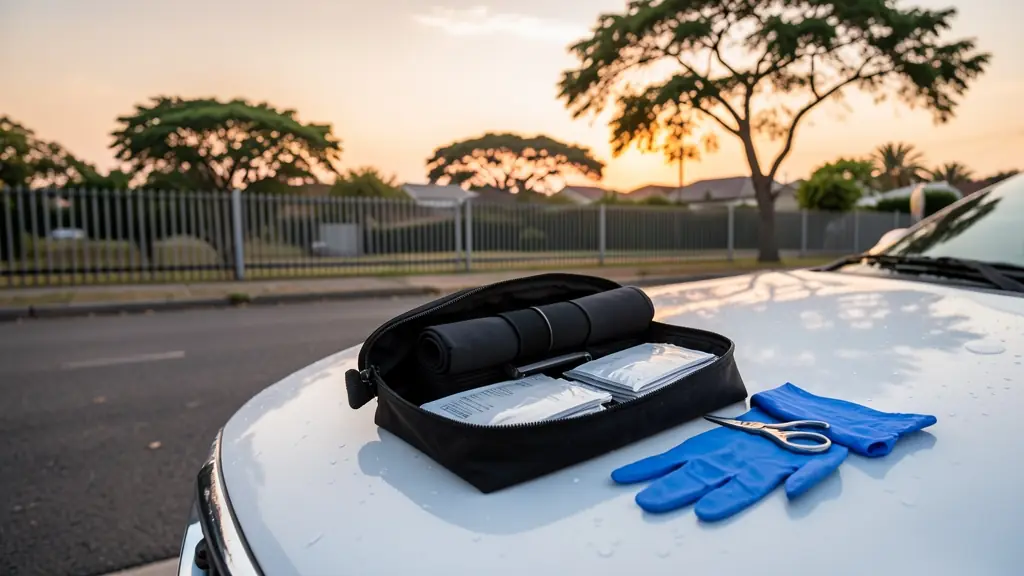
A trauma kit is built for the few minutes after a gunshot, a stab wound, a hand caught in a machine or a bakkie rollover, when blood loss can kill before an ambulance arrives. It does one job, stopping severe bleeding, and sits beside the ordinary first aid box. The moment heavy bleeding starts, send a bystander to phone 10177 (112 if only a cellular handset is at hand, or the medical aid card's own emergency line) and start working on the wound.
Price guideQuoted on requestThe contents, the people, the hours and what is included change the price too much for a fair published range. Ask two or three businesses to quote the same brief.
What a bleeding control kit holds
- Tourniquets, usually more than one, since a casualty can have two wounds.
- Trauma dressings: a thick pad on an elastic bandage that presses as you wrap it, the item most people call a pressure bandage.
- Haemostatic gauze (searched as hemostatic dressing): gauze treated to help a clot form, packed into a deep wound.
- Chest seals for a wound to the chest.
- Blunt tipped trauma shears, nitrile gloves in two sizes, a marker to write the time and a foil blanket.
Plain gauze and crepe bandages stay in the normal kit for everyday cuts.
Who carries one, and where it lives
Armed response cars and guardhouses, shooting ranges, mines and sawmills, farms an hour from a hospital and game lodges whose guides track on foot. A tactical first aid kit is the same idea on a belt or vest so it travels with the person. Malls, schools and stadiums increasingly put a bleeding control kit in a public access cabinet next to the AED, where a bystander can grab both.
The principles a course drills into you
Firm direct pressure on the wound comes first. For life threatening bleeding from an arm or a leg, a tourniquet goes on high and tight, the time is written down, and nobody loosens it before hospital. Where a tourniquet cannot go, such as the groin or the armpit, the wound is packed with gauze and pressed hard. Reading this is not practice: a bleeding control course or a first aid course has you tighten a tourniquet on yourself until you know how much it takes. The hospital decides the treatment from there.
Copies, expiry dates and how kits are priced
Cheap tourniquet copies sold online have rods that snap and buckles that slip. Buy from a supplier who can say who made it and that it is genuine, and keep a separate training tourniquet so the real one is never worn out. Haemostatic gauze and chest seals carry expiry dates. Kits are priced by the contents and the pouch or case; run the first aid kit checklist against any list you are quoted.
Who asks for this
- Families and carers
- A compact bleeding kit for a household with power tools, firearms or a long drive to hospital.
- Offices, shops and salons
- A bleeding control kit in the reception cabinet next to the AED for staff and visitors.
- Factories, mines and sites
- Tourniquets and trauma dressings at sawmills, mines and machine shops where crush and cut injuries happen.
- Schools, creches and clubs
- A public access kit in the school hall and one on the bus for sports tours.
- Clinics, practices and care homes
- Trauma stock for clinic emergency rooms and sisters who see stab and gunshot wounds.
- Events and venues
- Bleeding control kits carried by the medics and stored at the first aid post.
- Farms, lodges and the outdoors
- Tourniquets for hunting farms, shooting ranges and lodges where guides walk far from any road.
- Vehicle fleets
- A trauma pouch in every armed response car and site vehicle, sealed and dated.
Frequently asked questions
Is a trauma kit the same as a first aid kit?
No. A first aid kit covers cuts, burns, sprains and small wounds. A trauma kit is only for bleeding that could be fatal. A guard post, a range or a farm usually needs both.
Can someone without training use a tourniquet?
The devices are simple, but most people do not tighten one enough on the first try. That is why short bleeding control courses exist: practise on a trainer before you need the real one.
How often should a trauma kit be checked?
After every use, and on a fixed date each month for a kit in a vehicle or a cabinet: seals intact, nothing taken, expiry dates on the gauze and the seals, and the tourniquet still in its pouch and not cracked by sun.
Does firstaidkit.co.za sell trauma kits?
No. Our role is to hand your request on to kit and medical suppliers near you; each one prices it itself. Say how many kits, for vehicles, people or cabinets, and whether you want training.
Related topics
Work it out first
- Workplace first aid calculatorEmployees, shifts, sites, floors and the kind of work in: the first aid boxes and first aiders to plan for
- First aid kit checklistA kit type and the number of people in: a printable tick list of contents with guide quantities
- Kit restock calculatorKits, people, how often small injuries happen and the months between checks in: a reorder list and check dates