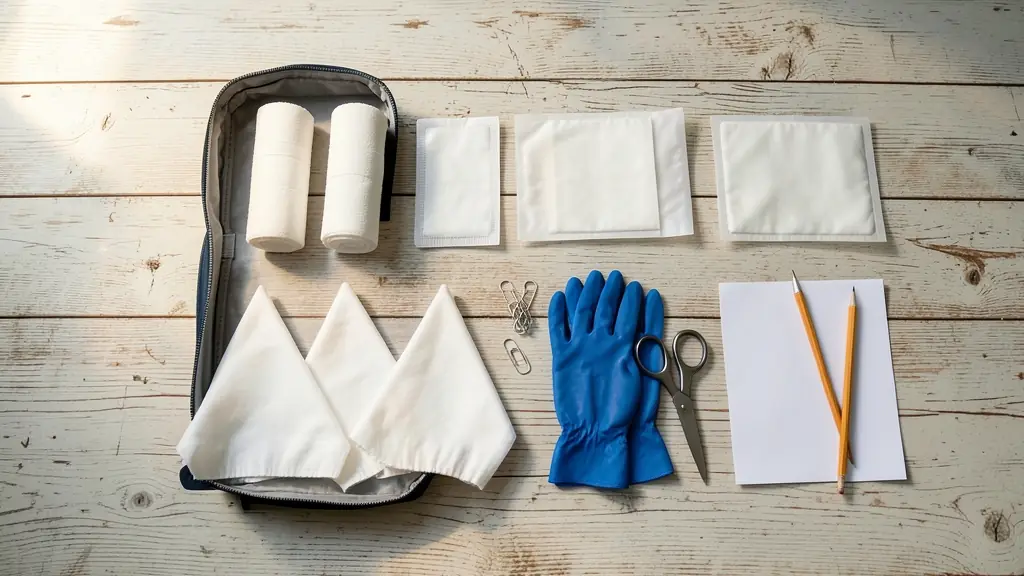
A first aid kit checklist turns a bag of loose packets into something you can check in five minutes. Choose the kind of kit, type the number of people, and the tool lists what belongs inside with a guide quantity, a tick box and a blank column for the expiry date. Print it and keep it in the lid. What goes in each kind of kit, and why, is on the first aid kit contents page.
Six lists, one for each use
A home kit leans on plasters, small dressings, a thermometer and a burn dressing for the kitchen. The office or workplace list follows the items on the minimum list in the General Safety Regulations, with the quantities commonly quoted: wound cleaner, swabs, gauze, triangular and roller bandages in two widths, dressings in two sizes, splints, gloves in two sizes and CPR mouthpieces. A car kit adds a foil blanket, seat belt shears and a torch; a sports kit adds cold packs, blister plasters and strapping; a creche kit uses child plasters and an infant face shield; the burns pack adds hydrogel dressings to any kit.
Quantities are a guide
Each list is sized for a group: about 6 for a home, 50 for the workplace box, 5 for a car, 10 for a team or a creche room. Type more people and the consumables go up in whole groups while the scissors and the tweezers stay at one. Past one group, two kits in two places often beat one big kit in a cupboard. None of these numbers is a legal figure: for a workplace, ask the supplier which list its kit follows, and let the risk assessment add items such as eye wash or extra burn dressings.
Ticking is half the check
The commonest problem is not a missing item but a dead one: a sterile dressing with a torn wrapper, gloves gone sticky in a hot car, wound cleaner past its date, a plaster box with three left. As you tick, read the date on every packet and write the earliest one in the last column. Throw out anything open, damp or expired. Medicines are left off the lists on purpose: ask the pharmacist what suits your household or workplace and who may give it.
After the check
Whatever you could not tick becomes your order. A supplier can quote for the missing items, a full refill pack or a restock visit; for loose items see bandages and plasters. For a workplace with several boxes, the kit restock calculator works out what to keep in the stock cupboard and when to check again.
Frequently asked questions
What must a workplace first aid box contain?
As commonly read, the items on the minimum list in the General Safety Regulations, such as wound cleaner, gauze, triangular and roller bandages, dressings, splints, gloves and CPR mouthpieces. Ask the supplier which list its kit follows and check the current regulations.
How do I print the checklist?
Use the print button under the list, or your browser's print. The form is left off the page and the list prints with the ticks and a blank column for expiry dates.
Should I put painkillers in the kit?
The lists leave medicines out. Ask your pharmacist or doctor; at work, a first aider usually may not hand out medicines.
Can I get a quote for a full kit instead?
Yes. Send a request with the kind of kit and the number of people, and suppliers near you quote. We sell nothing ourselves.
Read more
More tools
- Workplace first aid calculatorEmployees, shifts, sites, floors and the kind of work in: the first aid boxes and first aiders to plan for
- Kit restock calculatorKits, people, how often small injuries happen and the months between checks in: a reorder list and check dates
- AED response time calculatorWalking distance, floors, stairs or lift and the cabinet in: minutes to bring the AED against a 3 minute aim
- CPR metronomeA rate of 100 to 120 a minute and a mode in: a click, a light and a 30 and 2 count for practice on a manikin
- Blood pressure checkerThe top and bottom numbers and the pulse in: the common category and what to do next, not a diagnosis
- Burn area calculatorAdult or child and the areas burnt in: a rough share of the body by the rule of nines and when to get help
- Oxygen duration calculatorA cylinder's size, gauge and flow, or a concentrator's watts and a battery in: how long the oxygen lasts