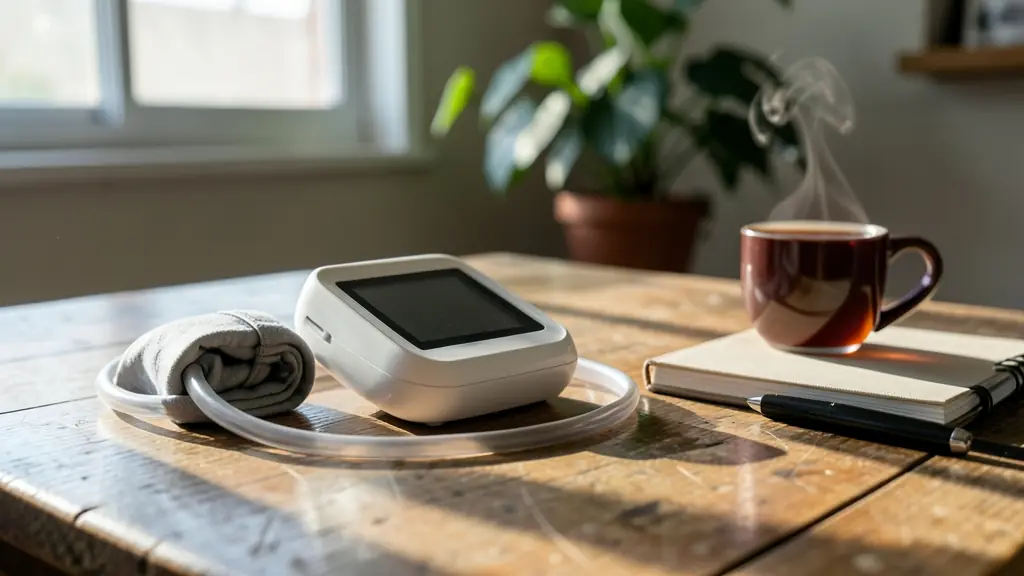
A blood pressure monitor at home turns one reading at the clinic into a picture your doctor can use. The man in Polokwane with a new script, the daughter checking her mother's pressure every Sunday and the pharmacy offering free checks all need the same thing: a monitor that fits the arm and gives the same number twice. Here is how to choose one and get readings worth writing down.
Price guideA pharmacy lists wrist monitors from about R462 and upper arm monitors from about R570 to R1,900. A replacement cuff is about R257 to R325A rough guide from published South African prices. The contents, the quantities, the make, delivery and VAT all move it.
Upper arm monitor or wrist blood pressure monitor
An upper arm monitor is usually the more reliable choice and the one most doctors ask for. A wrist blood pressure monitor is small and handy for travel, but it reads well only when the wrist is held at heart level, and a wrist cuff strapped to a forearm will give a new number every time. Ask the supplier whether the model has been validated against a recognised protocol; that is the question that separates a good monitor from a cheap gadget.
Get the blood pressure cuff size right
Measure around the middle of the upper arm with a tape before you order. A cuff that is too small reads high; one that is too big reads low. Standard cuffs fit most adults, but a large arm needs a large cuff and a slim teenager may need a small one. Many monitors take extra cuffs, so a household with two very different arms can share one machine.
Taking a reading the doctor can trust
- Sit for about 5 minutes first, back supported, feet flat, legs uncrossed.
- Rest the arm on a table with the cuff at heart level, on bare skin.
- Do not talk, and skip coffee or a cigarette in the half hour before.
- Take two readings a minute apart, at the same times each day.
- Keep a log, or use the memory, and take it to the GP.
A reading under about 120/80 is commonly called normal and 140/90 or more is commonly called high; the doctor reads your numbers, not the box. Try the blood pressure checker to see the common category. A reading above about 180/120 with chest pain, a bad headache, weakness or confusion is an emergency: call 10177 or 112.
Features worth paying for
Memory for two users, a date and time stamp, an irregular heartbeat warning, a large screen for older eyes and mains power as well as batteries. Clinics, pharmacies and care homes buying several should ask about calibration checks and spare cuffs. Pair it with a pulse oximeter or a thermometer for a home care drawer.
Who asks for this
- Families and carers
- A validated upper arm monitor for someone on a new script, with readings logged for the GP.
- Offices, shops and salons
- A monitor in the wellness room for staff health days and the occupational nurse.
- Factories, mines and sites
- The site clinic checking drivers and operators at medicals and after a dizzy spell.
- Schools, creches and clubs
- A monitor in the sick bay of a boarding school or a university health centre.
- Clinics, practices and care homes
- Pharmacies, GP rooms and care homes buying several with spare cuffs in different sizes.
- Events and venues
- A monitor in the medical tent kit, used by the medics on a hot race day.
- Farms, lodges and the outdoors
- A wrist monitor packed for a long trip by someone the doctor asked to keep checking.
- Vehicle fleets
- Occupational health checks for truck and bus drivers before a long route.
Frequently asked questions
How do I know my monitor is accurate?
Take it to your next clinic or GP visit and compare it with their reading on the same arm. If the numbers are far apart, ask the supplier about a check or a replacement.
Does a monitor diagnose high blood pressure?
No. It measures. Only a doctor or a clinic sister diagnoses and decides on treatment, usually from several readings over days or weeks. Never change your tablets because of a home reading.
Which arm should I use?
Your doctor may tell you to check both once and then use the arm that reads higher. After that, stay with the same arm each time so the readings can be compared.
How are monitors priced?
Per monitor, by upper arm or wrist, validation, memory and features, and extra cuffs. A pharmacy or clinic ordering several usually gets a better unit price. Your medical aid may pay with a script.