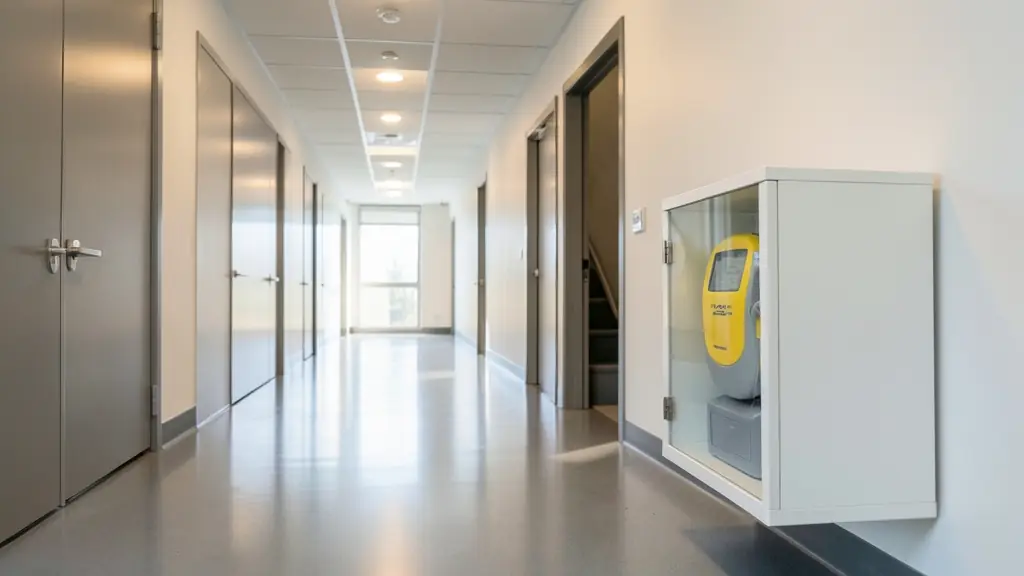
An AED response time calculator tells you whether the defibrillator on the wall is close enough to matter. In a cardiac arrest, survival drops roughly 7 to 10% for every minute without CPR and defibrillation, so many plans aim to get an AED to the patient within about 3 minutes. That is a fetch there and back, plus the time before anyone runs. Read about the machines on the defibrillators page.
What the time is made of
The tool adds four parts. First the wait before someone is sent, 30 seconds by default, because people first check, shout and call. Then the walk to the AED and back along the real route, not the straight line on a plan. Then the floors, both ways, by stairs or lift. Last the cabinet: an open bracket takes a few seconds, an alarmed cabinet a few more, and a locked office whose key is in the manager's car can take minutes. Every one of these is our stated assumption, and you can change the pace and the wait.
Walking speeds and stairs
The tool uses about 1.3 m a second for a normal walk, near the figures design guides use, 1.8 for a brisk walk and 2.5 for jogging with the bag; the last two are ours. Stairs cost about 15 seconds a floor at a walk and less at a jog, each way. A lift adds a wait at the door and a few seconds a floor; in a busy building or during load shedding the stairs may be the only choice. Walk the route with a stopwatch once and type your own times.
How far one AED reaches
Turn the sum around and the tool gives the walking distance one AED covers within the 3 minutes at the chosen pace, with your floors and cabinet. If the answer is shorter than your building, the choices are a second unit, a more central spot or an open bracket at a manned desk. Large estates, schools, gyms and malls often need more than one.
Meanwhile, CPR
While the AED is on its way, someone starts CPR and someone calls 10177, or 112 from a cell phone. An AED talks the user through each step and only shocks if it finds a shockable rhythm, so a bystander can use one, but first aid training makes it faster and calmer. Practise the beat with the CPR metronome, and keep the pads and battery in date; see first aid kits for the kit that sits beside it.
Frequently asked questions
How close should an AED be?
Many plans aim for the AED to reach the patient within about 3 minutes. At a brisk walk with no stairs, that is roughly 120 to 130 m of walking route each way once the first moments are counted.
Should the AED be in a locked cabinet?
A lock adds time and the key goes missing. Many sites use an open bracket or an alarmed cabinet in a place where staff can see it.
Do I need training to use an AED?
An AED talks you through each step and shocks only if it finds a shockable rhythm, so an untrained bystander can use one. Training helps a great deal; ask a training provider.
Can I get quotes for an AED and a cabinet?
Yes. Send a request with the building, the floors and how many units, and suppliers near you quote. We sell no devices ourselves.
Read more
More tools
- Workplace first aid calculatorEmployees, shifts, sites, floors and the kind of work in: the first aid boxes and first aiders to plan for
- First aid kit checklistA kit type and the number of people in: a printable tick list of contents with guide quantities
- Kit restock calculatorKits, people, how often small injuries happen and the months between checks in: a reorder list and check dates
- CPR metronomeA rate of 100 to 120 a minute and a mode in: a click, a light and a 30 and 2 count for practice on a manikin
- Blood pressure checkerThe top and bottom numbers and the pulse in: the common category and what to do next, not a diagnosis
- Burn area calculatorAdult or child and the areas burnt in: a rough share of the body by the rule of nines and when to get help
- Oxygen duration calculatorA cylinder's size, gauge and flow, or a concentrator's watts and a battery in: how long the oxygen lasts