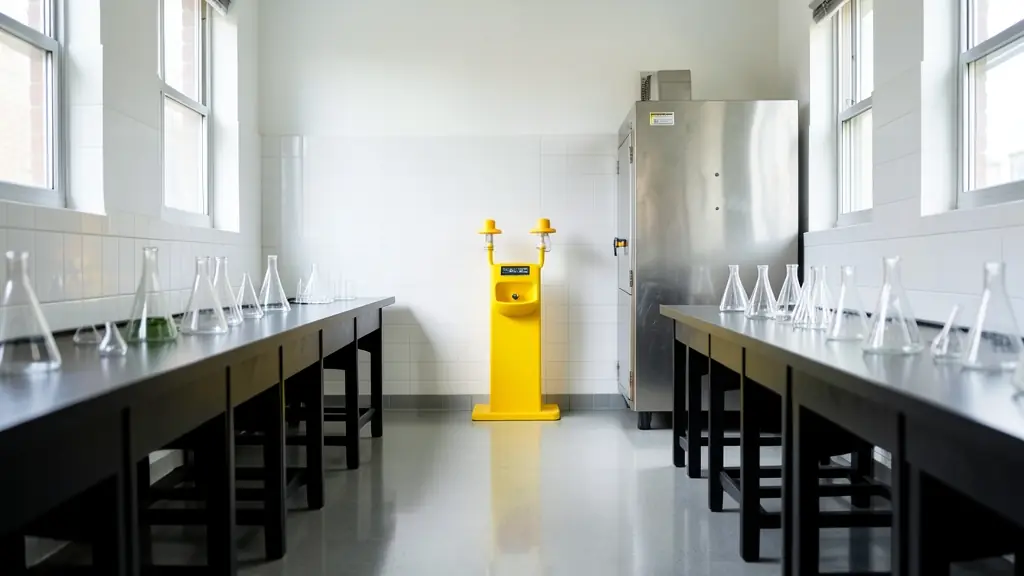
An eye wash station is built for one moment: a splash of acid, alkali, solvent or battery fluid in someone's eyes, when every second counts. It gives a soft, steady flow of clean water to both eyes while the hands hold the lids open. Labs, battery charging bays, chemical stores, pool chemical rooms and workshops need one where workers can get to it with their eyes shut.
Price guideA first aid supply store lists self contained double bottle eye wash stations at about R258 to R353 and a 250 ml bottle at R19, while plumbed eye wash basins cost about R7,426 wall mounted to R10,632 foot operatedA rough guide from published South African prices. The contents, the quantities, the make, delivery and VAT all move it.
Plumbed, portable or a bottle
- Plumbed stations connect to the water supply: wall mounted, on a pedestal, or a combination unit with a drench shower for whole body splashes.
- Portable self contained stations hold a tank of flushing fluid for sites with no plumbing, such as a farm chemical shed or a remote pump house.
- Sealed eye wash bottles are for dust and a first flush on the way to a station, not for a chemical splash on their own.
Stations are priced per station; plumbed units also need a plumber, and portable units need the right fluid and preservative.
Ten seconds to reach, fifteen minutes to flush
Most eye wash suppliers quote the standard they follow: reach the station within about 10 seconds, on the same level as the hazard with no doors or stairs in the way, and flush with clean running water for at least 15 minutes, holding the eyelids open. The water should be tepid. Water in a pipe across a sunny roof in Polokwane can run hot, and a Free State winter morning makes it painfully cold; either way people stop flushing too soon. Ask the supplier about a mixing valve where that is a risk.
The sign, the path and the weekly test
An eye wash station sign above the unit shows where it is from across the room, and the path to it stays clear: no pallets, mop buckets or stacked drums. Plumbed stations are tested weekly: open the valve, let stale water run through, check that the caps pop off and both streams rise evenly, and write it in the log. Portable units have their fluid changed on the maker's schedule, and bottles opened once are replaced, not kept for a year.
After the flush
Keep flushing on the way to help if you can, then see a doctor every time, even when the eye feels better. For a serious splash, call for help: 10177 for the state ambulance, 112 on a mobile, or your medical aid's emergency line. Have the chemical's safety data sheet ready for the doctor. A first aid course covers eye injuries; pair the station with a burn kit where chemicals also burn skin.
Who asks for this
- Families and carers
- A sealed bottle near the pool chemicals and the garage battery charger.
- Offices, shops and salons
- A bottle station beside the cleaning store where strong detergents are mixed.
- Factories, mines and sites
- Plumbed stations at chemical stores, battery charging bays, plating lines and workshops.
- Schools, creches and clubs
- A station in every science lab and the pool pump room at the sports centre.
- Clinics, practices and care homes
- A unit in the sterilising room and wherever disinfectants and lab reagents are handled.
- Events and venues
- Bottles at the generator and fuel point and with the pyrotechnics crew.
- Farms, lodges and the outdoors
- A portable station at the farm spray shed and dip tank far from plumbing.
- Vehicle fleets
- A station at the workshop battery bay and bottles in the service vehicles.
Frequently asked questions
Is the eye wash bottle in the first aid kit enough?
For grit or dust, often yes. Where chemicals are handled, a bottle only buys time on the way to a plumbed or portable station; it does not hold enough for a full flush. Check your kit contents and your risk assessment.
Do I need an eye wash station sign?
A sign helps anyone, including a visitor or a new worker, find the station quickly. Your health and safety officer will say which safety sign standard your site follows, and most suppliers can include one with the station.
Who installs a plumbed station?
A plumber connects it to the supply and the drain. Many suppliers can arrange the fitting, so say whether you want supply only or supply and installation.
Does firstaidkit.co.za sell eye wash stations?
No. We pass your request to safety and first aid kit suppliers near you, and they quote you directly. Use the workplace first aid calculator to plan your other first aid needs.