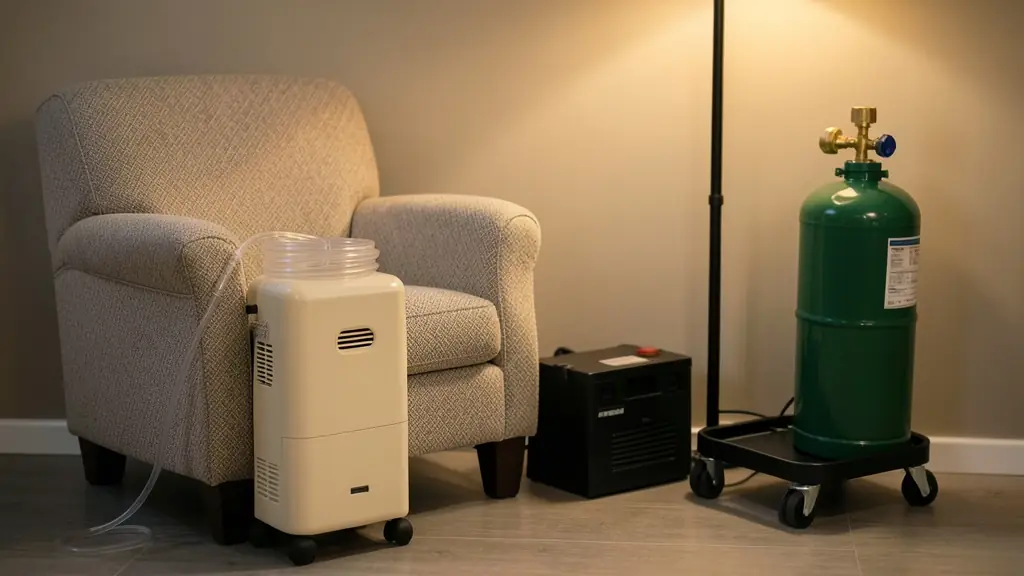
An oxygen duration calculator answers the question carers ask most: how long have we got? For a cylinder it turns the size, the gauge and the flow your doctor prescribed into minutes, keeping a reserve. For a concentrator, which needs power, it works out how many hours a battery and inverter keep it running when the lights go out. The machines and how they are supplied are on the oxygen concentrators page.
A cylinder: litres and minutes
Cylinders are sized by water capacity, the litres of water the empty shell would hold. Multiply that by the gauge pressure in bar and you get, roughly, the litres of oxygen inside: a cylinder of about 5 L water capacity at 150 bar holds about 750 L. Divide by the flow in litres a minute for the minutes. The tool first keeps 20 bar back as a reserve, our assumption, so you change the cylinder before it runs dry. The sum ignores the small difference real gas makes at these pressures; the supplier's figure for your cylinder is better if you have it.
Flow and conserving devices
Use only the flow your doctor prescribed. The tool assumes continuous flow; a pulse or conserving device gives oxygen only as you breathe in and can make a cylinder last much longer, by an amount that depends on the device and the breathing. Cold makes the gauge read low, and a slow leak at the regulator drains a cylinder unnoticed, so check the gauge before you rely on it. Keep oxygen away from flames, heaters and smoking, and store cylinders upright and secured.
A concentrator through load shedding
A home concentrator draws power all the time it runs, often a few hundred watts; the label gives the figure. The tool takes the battery size in Wh, or amp hours x volts, keeps back the part you should not use (about 10% of a lithium battery and half of a lead acid one, our figures), takes off about 15% for the inverter, and divides by the watts. It compares the result with load shedding slots of 2, 2.5 and 4 hours, and suggests an inverter of at least twice the running watts for the compressor starting. These are our assumptions; an installer sizes the real system.
Keep a backup for the backup
Batteries age and give less each year, and a long outage can outlast any battery. Keep a full cylinder as the second backup, know how long it lasts, and ask the supplier how quickly a refill arrives. Ask your medical aid what it pays for and what it needs from the doctor. For monitoring at home, see pulse oximeters; for nebulised medicines, nebulisers; and for hire or purchase of beds, hospital beds. If someone struggles to breathe, call 10177, or 112 from a cell phone.
Frequently asked questions
How long does a small oxygen cylinder last at 2 L/min?
A cylinder of about 2 L water capacity at 150 bar holds about 300 L; keeping 20 bar back, that is about 260 L, or a little over 2 hours at 2 L/min.
Will my concentrator run on an inverter?
Usually, on a pure sine wave inverter big enough for the start surge, with a battery sized for the hours you need. Ask the supplier of the unit before you connect it.
Can I turn the flow up to feel better?
Use only the flow your doctor prescribed. Ask the doctor before changing it.
Can I get quotes for oxygen and backup power?
Yes. Send a request with the unit, the flow and the hours you need covered, and home care suppliers near you quote. We supply no oxygen or devices ourselves.
Read more
More tools
- Workplace first aid calculatorEmployees, shifts, sites, floors and the kind of work in: the first aid boxes and first aiders to plan for
- First aid kit checklistA kit type and the number of people in: a printable tick list of contents with guide quantities
- Kit restock calculatorKits, people, how often small injuries happen and the months between checks in: a reorder list and check dates
- AED response time calculatorWalking distance, floors, stairs or lift and the cabinet in: minutes to bring the AED against a 3 minute aim
- CPR metronomeA rate of 100 to 120 a minute and a mode in: a click, a light and a 30 and 2 count for practice on a manikin
- Blood pressure checkerThe top and bottom numbers and the pulse in: the common category and what to do next, not a diagnosis
- Burn area calculatorAdult or child and the areas burnt in: a rough share of the body by the rule of nines and when to get help