A first aid course is the difference between a kit on the wall and someone who knows what to do with it. Employers book first aid training because the law expects a certified first aider on each shift; parents and creche staff book it after a scare with a choking toddler. Whichever applies, the level, the provider's accreditation and the practical time on a manikin are what you are paying for.
Price guideA national safety training provider lists First Aid Level 1 (2 days) from about R1,280 and Level 2 (3 days) at R2,345 a learner; its course page shows the Level 2 fee excl. taxA rough guide from published South African prices. The contents, the quantities, the make, delivery and VAT all move it.
Level 1, 2 and 3 in plain words
- Level 1 (basic, about 1 to 2 days): scene safety, CPR on adults, children and babies, choking, bleeding, burns, shock, fractures and the recovery position. Most offices and shops start here.
- Level 2 (intermediate): more on injuries, medical emergencies, moving a casualty and running an incident. Suits factories and bigger sites.
- Level 3 (advanced, about 4 to 5 days in total): deeper assessment and managing serious incidents until the ambulance arrives, often chosen for mines, construction and remote work.
The names and the hours differ a little between providers, so ask for the outline.
What you should practise on the day
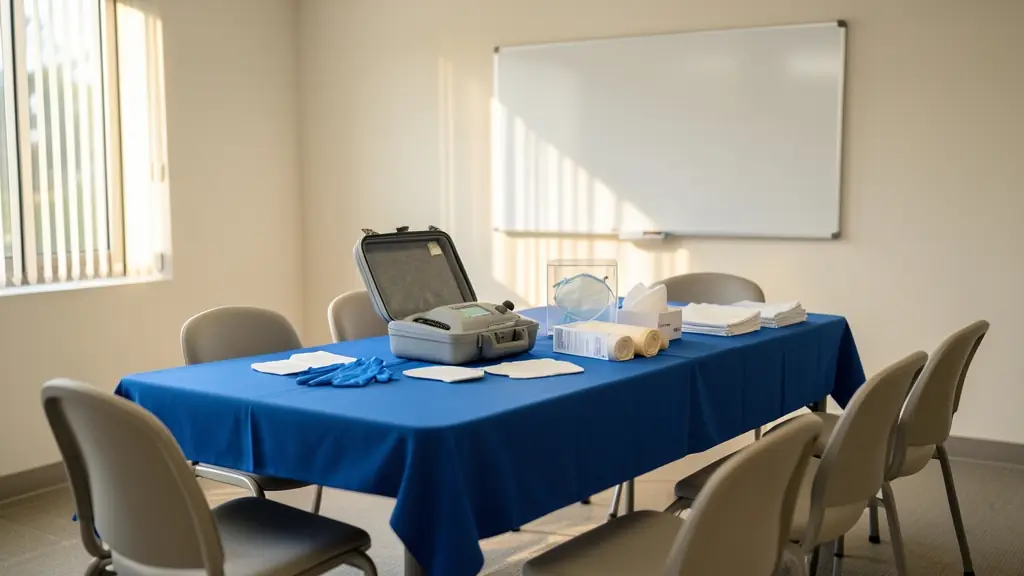
Most of a good course happens on the floor. Expect to do CPR on a manikin at about 100 to 120 compressions a minute, about 5 to 6 cm deep, with 30 compressions and 2 breaths. You should open an AED trainer and follow its prompts, apply pressure and a bandage, cool a pretend burn and practise back blows for choking. Online theory followed by an assessed practical day is common now; a course with no hands on part rarely satisfies a workplace audit. Keep the rhythm fresh afterwards with the CPR metronome.
Workplace first aiders and the paperwork
As most providers read the General Safety Regulations, a workplace with more than 10 people needs one certified first aider per 50 staff, shift by shift, and the course must be run by a training provider holding approval from the Department of Employment and Labour. Many courses link to QCTO or SAQA unit standards and the HWSETA. Certificates commonly last 3 years, so file a copy and diarise the refresher: a warehouse can pass an audit in March and fail it in June because its only first aider resigned. The workplace first aid calculator shows how many people to send.
Public course or a group on site
One or two learners usually join a public course at the provider's venue and pay per learner. Eight or more often makes on site training cheaper, priced per group, with scenarios set in your own kitchen or workshop. Creches and parents can ask for an infant and child course. Every course repeats the basics: in a real emergency, phone 10177 for a public ambulance or dial 112 on a mobile, and leave treatment decisions to the hospital. See workplace kits and defibrillators for the kit side.
Who asks for this
- Families and carers
- Parents, grandparents and domestic workers learning CPR and choking help for small children.
- Offices, shops and salons
- A receptionist and a manager trained as first aiders so every shift has one.
- Factories, mines and sites
- Level 2 and 3 first aiders for factories, mines and construction sites with real injury risk.
- Schools, creches and clubs
- Teachers, coaches and creche staff trained in child CPR before the sports season.
- Clinics, practices and care homes
- Carers and reception staff at practices and care homes keeping certificates current.
- Events and venues
- Marshals and volunteers at races and festivals who see the casualty before the medics.
- Farms, lodges and the outdoors
- Field guides and farm supervisors trained for injuries hours from a hospital.
- Vehicle fleets
- Drivers of buses and delivery vehicles who are often first at a roadside crash.
Frequently asked questions
Which level do my staff need?
Level 1 meets the usual workplace requirement for low risk work. Higher risk sites often send people to Level 2 or 3, guided by the risk assessment and the health and safety officer.
Is a first aid course near me cheaper than on site training?
For a few people, usually yes. For a group, the provider coming to you saves travel and lost shifts. Ask for a per learner price and a per group price and compare.
How do I check a provider is accredited?
Ask to see the labour department approval letter and the unit standards listed, then make sure each certificate shows the learner's name, the level and the date.
Does firstaidkit.co.za run courses?
No, we train nobody. Training providers near you receive the request and reply with prices and course dates.
Related topics
Work it out first
- Workplace first aid calculatorEmployees, shifts, sites, floors and the kind of work in: the first aid boxes and first aiders to plan for
- AED response time calculatorWalking distance, floors, stairs or lift and the cabinet in: minutes to bring the AED against a 3 minute aim
- CPR metronomeA rate of 100 to 120 a minute and a mode in: a click, a light and a 30 and 2 count for practice on a manikin
- Burn area calculatorAdult or child and the areas burnt in: a rough share of the body by the rule of nines and when to get help