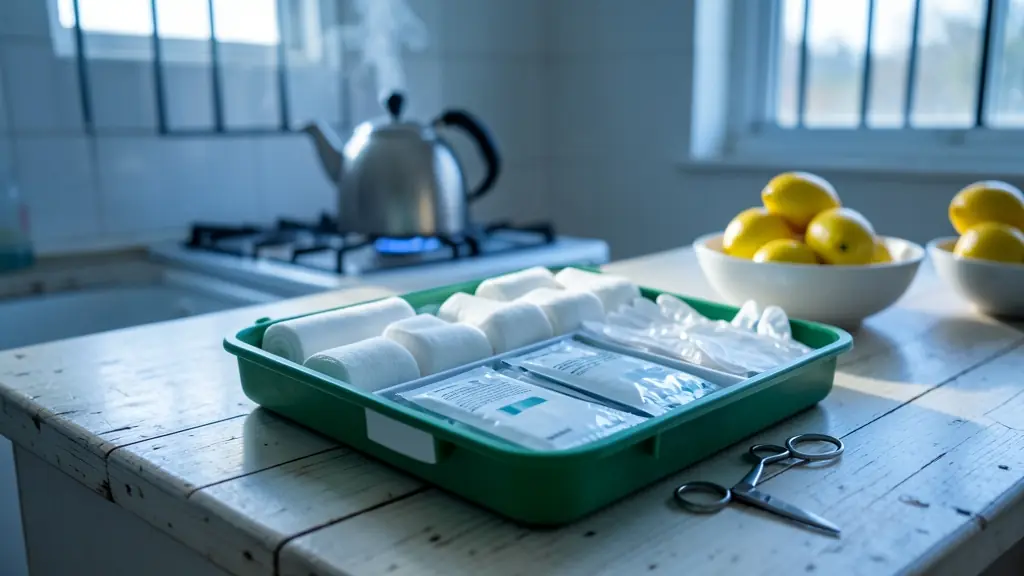
A first aid kit buys time. It lets someone stop bleeding, cover a burn, support a sprained wrist or clean a grazed knee in the minutes before a nurse, a GP or a paramedic takes over. For anything serious, phone 10177 for a state ambulance or dial 112 on a mobile, or use the emergency line printed on your medical aid card. The kit itself is a box of supplies; what makes it useful is choosing the right one and keeping it full.
Price guideA pharmacy lists a 44 piece all purpose kit at about R150 and a small household kit bag at R410, and a first aid supply store lists Regulation 7 workplace kits from about R301 in a plastic toolbox to R714 in a grabber bagA rough guide from published South African prices. The contents, the quantities, the make, delivery and VAT all move it.
The kinds of kit, and where each one belongs
- A home kit for cuts, small burns and splinters, kept high and away from children.
- A first aid box on the wall at an office, salon or shop.
- A workplace kit built to the OHS Act list, commonly called a Regulation 7 kit, for employers.
- A compact car kit for the boot, the bakkie or a whole fleet.
- Specialist kits for burns, eyes, bleeding, snakebite and babies, such as burn kits.
Choose by people, place and risk
Start with three questions. How many people could need it at once? How far is the nearest clinic or hospital? What could go wrong there? A Durban accounting office with twelve staff needs very different stock from a Limpopo citrus farm where the pack shed is an hour from town. Kitchens add burn dressings, workshops add eye pads and more gauze, remote sites add a foil blanket and splints. The workplace first aid calculator gives a rough count of boxes and first aiders for a business.
Why the contents beat the case
Two kits that look alike can hold half the stock of each other. Compare the contents list line by line, the number of each item, the expiry dates on the sterile packs and whether the supplier sells refills for that kit. A cheap kit with ten plasters and one pair of gloves runs dry after a single bad afternoon. Print the first aid kit checklist to compare what is offered.
Who sells kits, and how to ask
A first aid kit supplier, a medical supply company, a pharmacy and a safety supply store all sell them. Tell us the kind of kit, how many, for how many people, the type of work, your town and by when. We pass one request to several suppliers who quote you directly, and later refills can come from the same place.
Who asks for this
- Families and carers
- A family kit for grazed knees, kitchen burns and bee stings, stored out of reach.
- Offices, shops and salons
- A wall box for staff and visitors at offices, shops, salons and restaurants.
- Factories, mines and sites
- Larger kits near machines and loading bays, matched to the site's risk assessment.
- Schools, creches and clubs
- A kit in the sick bay, one per sports team and one on every school bus.
- Clinics, practices and care homes
- Practices and care homes keeping a kit for staff alongside their clinical stock.
- Events and venues
- Kits at the gate, the stage and the water points for organisers and volunteers.
- Farms, lodges and the outdoors
- Farms, lodges and hikers far from a clinic packing more dressings and a foil blanket.
- Vehicle fleets
- A compact kit under the seat of every taxi, bakkie, truck and response car.
Frequently asked questions
Does firstaidkit.co.za sell first aid kits?
No, and we keep no stock of any kind: no kits, no medicines, no devices. The service costs you nothing. Your request goes to independent suppliers that serve your area, and they reply to you themselves.
What is a basic first aid kit for a home?
Plasters in a few sizes, gauze swabs, a wound cleaner, two or three bandages, a sterile dressing, gloves, scissors, tweezers and a foil blanket cover most household knocks. Add a burn dressing if you cook a lot.
Is a first aid kit for business different from a home kit?
Usually yes. Employers with more than five staff are commonly expected to keep a box stocked to the legal minimum for workplaces. Get the supplier to name the list behind each kit it quotes.
Does owning a kit mean I know first aid?
No. A course teaches you to use what is inside, and a doctor, a nurse or the hospital decides the treatment after that. A short first aid course is worth more than an extra kit.
Related topics
Work it out first
- First aid kit checklistA kit type and the number of people in: a printable tick list of contents with guide quantities
- AED response time calculatorWalking distance, floors, stairs or lift and the cabinet in: minutes to bring the AED against a 3 minute aim
- CPR metronomeA rate of 100 to 120 a minute and a mode in: a click, a light and a 30 and 2 count for practice on a manikin