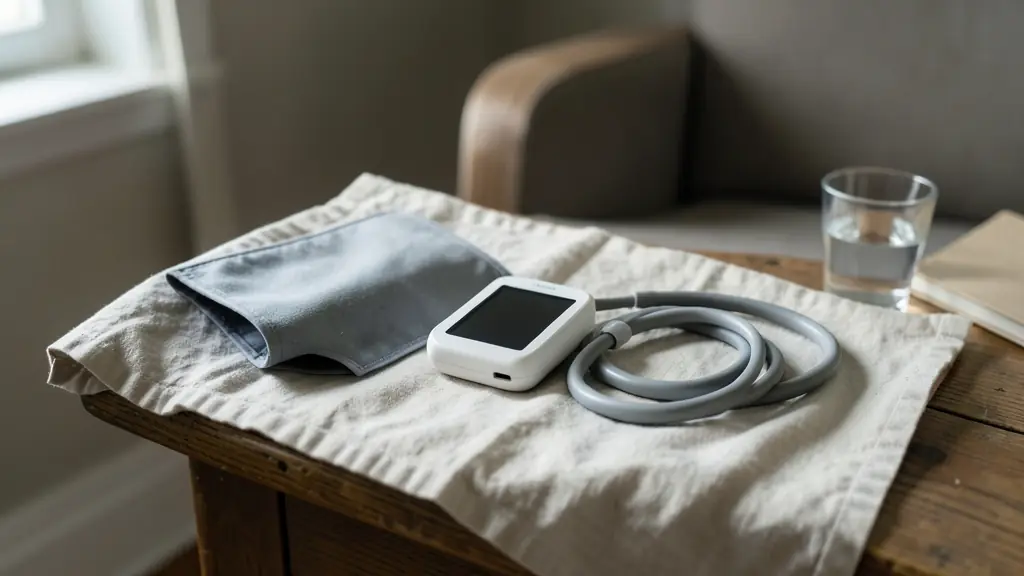
A blood pressure checker puts your reading next to the bands most guidelines publish for adults, so you know whether to carry on, keep a log or see a doctor. It does not diagnose anything: one reading says little, and a doctor, a clinic sister or a pharmacist reads your numbers with your history. For monitors, cuffs and what to ask for, see blood pressure monitors.
The two numbers
The top number, systolic, is the pressure as the heart pushes; the bottom one, diastolic, is the pressure between beats, both in mmHg. The tool uses the bands commonly published for office readings: under 120/80 optimal or normal, 130 to 139 over 85 to 89 high normal, 140/90 or more commonly called high in three grades, and above about 180/120 urgent. Whichever number lands in the higher band sets the category, so 150/82 is read as high because of the top number. Under about 90/60 is commonly called low and matters mostly with dizziness or fainting.
Measure it properly
Most odd readings are odd measurements. Sit with your back supported and feet flat for about 5 minutes, rest the arm at heart level, use the right cuff size on bare skin, and do not talk. Take two readings a minute apart, morning and evening, at the same times for a week, and write them down. Upper arm monitors are usually more reliable than wrist ones, and a monitor validated against a recognised protocol is the one to ask for. Coffee, a cigarette, a full bladder or a rush to the chair can all push the numbers up.
When to get help
A single high reading is a reason to measure again properly, not to panic. Repeated readings of 140/90 or more are a reason to see a doctor or clinic with your log. A reading above about 180/120 is a reason to sit quietly, measure again and see a doctor the same day. With chest pain, shortness of breath, a severe headache, weakness, confusion or changes in vision, call 10177, or 112 from a cell phone, whatever the numbers. Never stop or change a medicine because of a home reading: ask your doctor or pharmacist.
Your pulse
Many monitors show the pulse too. A resting pulse of about 60 to 100 a minute is commonly given as the usual range for adults; fit people often sit lower. An irregular beat warning on the monitor is worth mentioning to your doctor. Other home monitors are on the pulse oximeters and thermometers pages, and a home first aid kit sits well beside them.
Frequently asked questions
Is 140/90 high blood pressure?
140/90 or more is commonly called high when it is repeated on readings taken properly. Only a doctor diagnoses high blood pressure, usually from several readings over time.
Why does my reading change every time?
Blood pressure moves with breathing, talking, stress and position. Sit still, rest 5 minutes, keep the arm at heart level and average two readings.
Is a wrist monitor good enough?
Upper arm monitors are usually more reliable. A wrist monitor must be held at heart level, and a small movement changes the number.
Can I get quotes for a monitor?
Yes. Send a request with the cuff size you need, and pharmacies and medical suppliers near you quote. We sell no devices ourselves.
Read more
More tools
- Workplace first aid calculatorEmployees, shifts, sites, floors and the kind of work in: the first aid boxes and first aiders to plan for
- First aid kit checklistA kit type and the number of people in: a printable tick list of contents with guide quantities
- Kit restock calculatorKits, people, how often small injuries happen and the months between checks in: a reorder list and check dates
- AED response time calculatorWalking distance, floors, stairs or lift and the cabinet in: minutes to bring the AED against a 3 minute aim
- CPR metronomeA rate of 100 to 120 a minute and a mode in: a click, a light and a 30 and 2 count for practice on a manikin
- Burn area calculatorAdult or child and the areas burnt in: a rough share of the body by the rule of nines and when to get help
- Oxygen duration calculatorA cylinder's size, gauge and flow, or a concentrator's watts and a battery in: how long the oxygen lasts