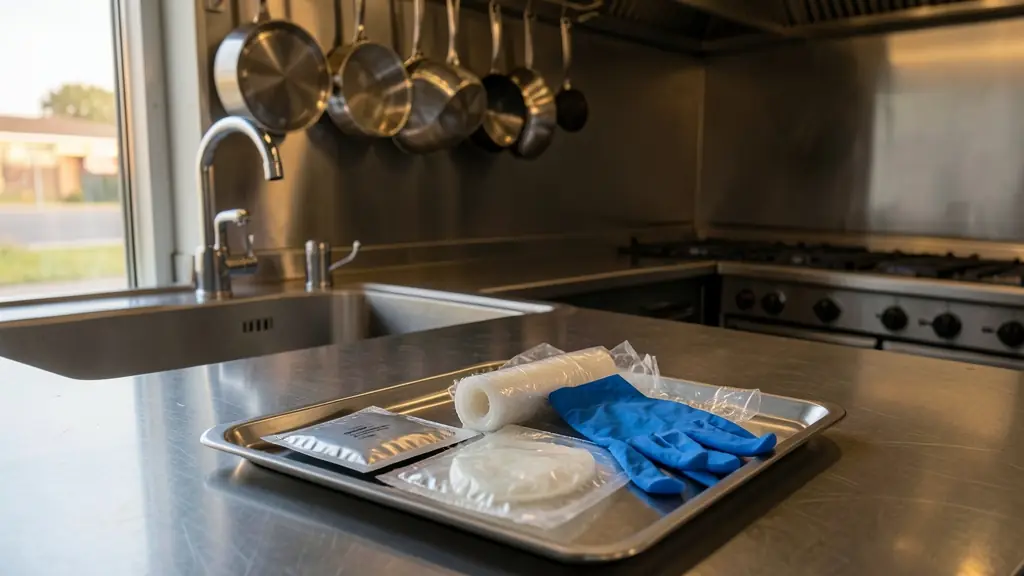
A burn kit belongs wherever there is hot oil, steam, molten metal or a welding arc: a restaurant line, a bakery, a foundry, a welding bay or a lab. It holds the gel dressings many people know by a brand name, plus the items that cover a burn cleanly. But no gel replaces the first step, which is cool running water, and a good kit is planned around the sink.
Price guideA pharmacy lists small burn kits at about R135 to R200, and a first aid supply store lists an essential burn kit in a bag at about R656. Hydrogel dressings run from about R17 (100 x 100 mm) to R297 (600 x 400 mm)A rough guide from published South African prices. The contents, the quantities, the make, delivery and VAT all move it.
Cool it first
The principle every course teaches: hold the burn under cool running water for about 20 minutes, starting as soon as you can. Take off rings, watches and anything tight before the area swells. No ice, no butter, no toothpaste. Then cover it loosely with cling wrap or a sterile non stick dressing. Gel dressings are for when there is no water nearby, such as a vehicle or a remote site, or for covering the burn after cooling. Practise it on a first aid course; what happens after cooling is for the doctor, the nurse or the burns unit to decide.
What goes in a burn kit
- Hydrogel burn dressings in several sheet sizes, the gel burn dressing most people call by its brand name.
- A face mask dressing for burns to the face and neck.
- Small gel sachets for minor kitchen burns.
- Cling wrap, sterile non adherent dressings and a light conforming bandage to hold them.
- Saline for rinsing, shears and gloves.
A kit is priced per kit by the number and size of the dressings and the case or wall box.
When to get medical help
Phone 10177 or 112, or your medical aid's emergency number, for a large burn, roughly bigger than the casualty's own palm, and for burns to the face, hands, feet, genitals or joints. Electrical and chemical burns always need a doctor, and so do burns on young children and the elderly, even small ones. The burn area calculator gives a rough size by the rule of nines and shows when to get help.
Sizing and storing the kit
A coffee shop with one espresso machine needs a few sachets and a small sheet; a foundry or a fryer line with several cooks needs bigger sheets, a face dressing and more of each. Chemical plants also need flushing for the eyes, see eye wash stations. Store gels out of the heat: not above the stove, beside the oven or near the furnace door, where the sachets dry out or burst. Check the dates and seals with your kit refills.
Who asks for this
- Families and carers
- A few gel sachets and a sheet in the kitchen drawer, well away from the stove.
- Offices, shops and salons
- A small kit in the staff kitchen beside the urn, the kettle and the microwave.
- Factories, mines and sites
- Larger burn kits in welding bays, foundries, boiler rooms and process plants.
- Schools, creches and clubs
- Burn dressings in the science lab, the home economics room and the tuck shop.
- Clinics, practices and care homes
- Burn dressings in the treatment room for patients who arrive after cooling at home.
- Events and venues
- Burn packs for food stalls, fire dancers and the braai area at a festival.
- Farms, lodges and the outdoors
- Gel dressings for camp fires and gas cookers where there is no running water.
- Vehicle fleets
- A gel pouch in vehicles where hot engines, exhausts and radiators cause burns.
Frequently asked questions
Is burn gel better than running water?
No. Cool running water for about 20 minutes is the first step wherever there is water. Gel dressings help when water is not available, or to cover the burn afterwards on the way to care.
Do burn gel dressings expire?
Yes. The gel can dry out and the seal can fail, so each dressing carries a date. Heat shortens their life, which is why a burn kit should not hang next to an oven or a furnace.
Can a burn kit replace the workplace first aid box?
No. It adds to the box built to the workplace kit list, for work where burns are a known risk. Your risk assessment and safety officer decide how many you need.
Which dressing suits a child's burn?
Smaller sheet sizes exist for children. Cool the burn, cover it and take the child to a doctor or the hospital, even if it looks small. A pharmacist can show you child sizes for a home kit.