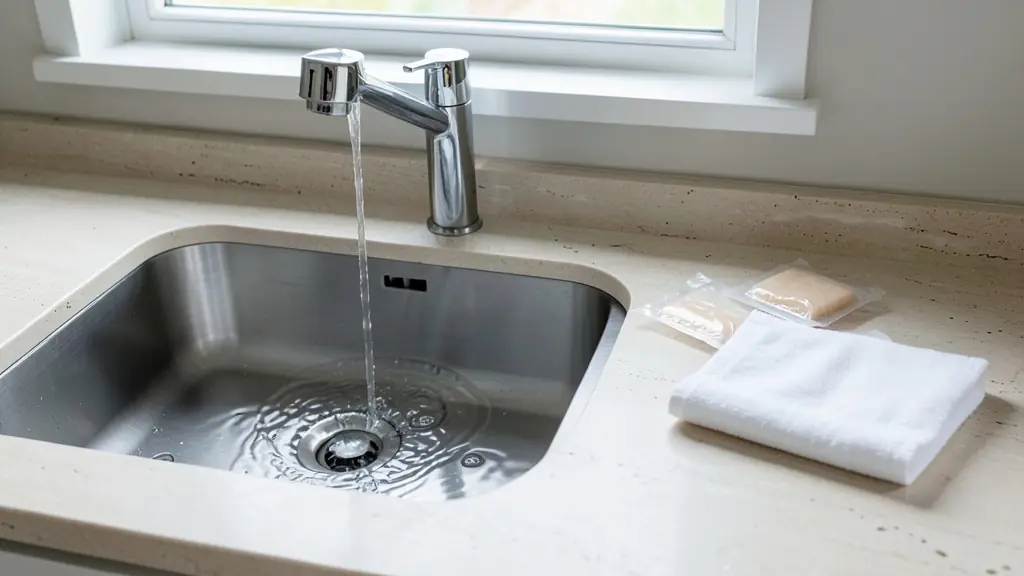
A burn area calculator gives a quick, rough answer to the question the call taker or the clinic will ask: how much of the body is burnt? It uses the rule of nines, which splits an adult body into areas of about 9% each, and a child version with a larger head. But the first thing is water: cool the burn under cool running water for about 20 minutes, then count. Burn dressings and kits are on the burn kits page.
The rule of nines
For an adult, the head and neck are about 9% of the body, each arm 9%, the front of the trunk 18%, the back 18%, each leg 18% and the groin 1%. The tool splits each into front and back, so you can pick a quarter, half, three quarters or all of an area. Small scattered patches are easier to count with the palm rule: the casualty's own palm with the fingers is roughly 1% of their body. Only count blistered or deeper skin; redness alone, as with sunburn, is usually left out.
Children and babies
A child's head is a much bigger share of the body and the legs a smaller one. For a baby under 1 the tool uses about 20% for the head and 16% for each leg. For a child of 1 to 9 it starts near 18% for the head and 13.5% for each leg and moves toward the adult figures each year, our simple step to the adult rule at about 10. Hospitals use a detailed chart for children; this is for the first minutes. Any burn on a baby or a child should be seen by a doctor.
When to get help
The tool always shows the list, whatever the percentage. Get medical help for a burn bigger than the casualty's palm; any burn to the face, hands, feet, genitals or over a joint; electrical and chemical burns and anyone who breathed in smoke; and any burn on a child or an older person. For a large burn, about 10% of an adult or 5% of a child as our guide, call 10177, or 112 from a cell phone, and keep cooling while you wait.
First aid in general terms
Cool running water for about 20 minutes, not ice, butter, oil or toothpaste. Take off rings and watches before the area swells, unless they are stuck. Cover loosely with cling wrap or a non stick sterile dressing and keep the person warm. Hydrogel burn dressings are for when there is no water, or after cooling. A first aid course teaches this properly, and the first aid kit checklist has a burns pack to add to a kitchen or workshop kit; see also eye wash stations for chemical splashes.
Frequently asked questions
What is the rule of nines?
A quick way to estimate burnt area on an adult: the head about 9%, each arm 9%, the front and back of the trunk 18% each, each leg 18% and the groin 1%. Children have a larger head share.
How long should I cool a burn?
Under cool running water for about 20 minutes. It still helps if you start a little late. Keep the rest of the person warm.
When is a burn serious?
Bigger than the casualty's palm, on the face, hands, feet, genitals or a joint, electrical or chemical, or on a child or older person: get medical help. Call 10177 or 112 for a large burn.
Where can I get burn dressings?
Send a request for a burn kit or a burns pack, and suppliers near you quote. We sell nothing ourselves.
Read more
More tools
- Workplace first aid calculatorEmployees, shifts, sites, floors and the kind of work in: the first aid boxes and first aiders to plan for
- First aid kit checklistA kit type and the number of people in: a printable tick list of contents with guide quantities
- Kit restock calculatorKits, people, how often small injuries happen and the months between checks in: a reorder list and check dates
- AED response time calculatorWalking distance, floors, stairs or lift and the cabinet in: minutes to bring the AED against a 3 minute aim
- CPR metronomeA rate of 100 to 120 a minute and a mode in: a click, a light and a 30 and 2 count for practice on a manikin
- Blood pressure checkerThe top and bottom numbers and the pulse in: the common category and what to do next, not a diagnosis
- Oxygen duration calculatorA cylinder's size, gauge and flow, or a concentrator's watts and a battery in: how long the oxygen lasts