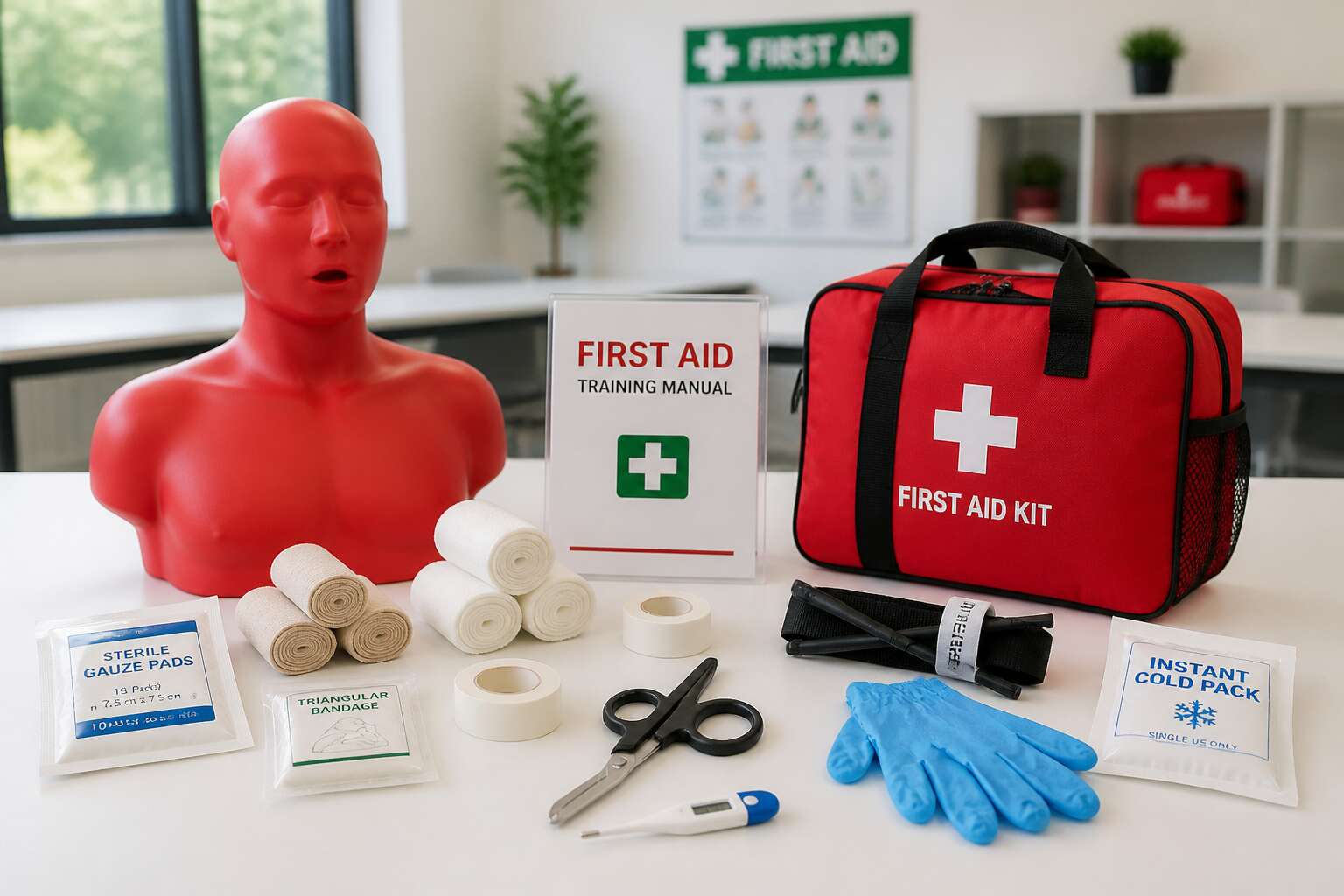
Core Supplies for Every Beginner Course
Wound Closure and Bandage Materials
In South Africa, trauma accounts for a significant share of emergency room admissions, yet many of those injuries could be stabilised long before professional help arrives. A well-considered first aid training equipment list makes that possible. For beginner courses, the focus should rest on tools that address the most common threats: uncontrolled bleeding, shock, and compromised airways. Disposable gloves, a pocket mask, and trauma shears form the non-negotiable core. Without these, no training session can properly simulate real response conditions.
- Disposable nitrile gloves, at least two pairs per trainee
- CPR face shield with a one-way valve
- Trauma shears capable of cutting through clothing and bandages
- Thermal blanket for shock management
Wound closure demands a different layer of preparation. Bandage materials must handle everything from minor abrasions to deep lacerations. Beginner courses should introduce conforming gauze, adhesive wound dressings, and elasticised bandages. These allow trainees to practise applying direct pressure, securing dressings, and elevating injured limbs. The right material often determines whether a wound stays clean or becomes infected. Choosing wisely during training builds instincts that carry over to real emergencies.
Sterile Gauze and Dressing Pads
Sterile gauze and dressing pads are the core component of any first aid training equipment list. They are cheap, versatile, and essential for controlling bleeding. In South African clinics, gauze is often the first thing used to pack a wound or cover a burn. Trainees need to know which pad suits which injury.
A standard kit should include:
- Individually wrapped sterile gauze squares in 5cm and 10cm sizes
- Non-adherent dressing pads for burns and abrasions
- Combine pads for heavy bleeding scenarios
Practising with these builds confidence. Handling sterile packaging without contamination is a skill. Learning to apply firm, even pressure over a dressing pad is another. Every beginner course must give trainees enough stock to make mistakes and try again. A first aid training equipment list that skips quality gauze leaves responders unprepared. The right pad buys precious time before emergency services arrive.
Antiseptic Solutions and Wipes
Before any dressing pad meets its mark, the wound must be clean. In South Africa, where emergency response times vary dramatically between urban and rural areas, proper antisepsis often determines whether a wound heals cleanly or turns septic.
Antiseptic solutions and wipes belong on every first aid training equipment list. They teach trainees to clean a wound thoroughly without causing further tissue damage. Chlorhexidine and povidone-iodine are common in local clinics, but alcohol-based wipes serve different purposes entirely.
- Povidone-iodine solution for contaminated wounds
- Chlorhexidine wipes for general skin cleaning
- Saline solution for flushing debris
Understanding concentration and contact time matters. A quick wipe does little if the solution evaporates before doing its work. Infection remains a leading cause of complications in South African emergency settings, so mastering antisepsis is non-negotiable.
Burn Relief and Cooling Gel Kits
Burns don’t wait for the ambulance. In South Africa’s informal settlements, paraffin stove accidents send thousands to emergency units each year. Cooling gel stops the damage in those first critical minutes.
Cooling gels pull heat from the wound, halting deeper tissue injury. This is why burn relief and cooling gel kits belong on any first aid training equipment list. Trainees must learn when to cool, when to cover, and when to call for transport.
- Hydrogel dressings for partial thickness burns
- Cooling spray for immediate field application
- Burn sheets to prevent contamination
The real skill is speed. A first aid training equipment list that includes burn relief items gives students the tools to act before the wound deepens. That matters in rural clinics where specialised burn care is hours away.
Splinting Boards and Triangular Bandages
Fractures in South Africa’s busy townships often happen far from the nearest emergency unit. A proper first aid training equipment list must include splinting boards and triangular bandages, because these turn a bystander into a stabiliser. Splinting boards immobilise the joint above and below the break. Triangular bandages, meanwhile, double as slings, arm supports, or even make do as a pressure bandage when sterile dressings run out.
- Two rigid splinting boards, one long, one short
- Four triangular bandages, preferably cotton
- Padding material, like rolled gauze or cloth
Students learn to secure the limb without cutting off circulation. That skill matters in rural areas where a taxi ride to the clinic takes an hour. The whole first aid training equipment list should not ignore these basics. They are cheap, reusable, and they teach the confidence to act before help arrives.
Simulation Manikins and Advanced Practice Gear
Full-Body CPR Manikins with Feedback Sensors
Less than one in ten South Africans who collapse from cardiac arrest outside a hospital survive. Bystander CPR can change that, but only if compressions are effective. Full-body CPR manikins with feedback sensors give trainees real time readouts on compression depth, rate, and chest recoil. These advanced practice gear items flag mistakes instantly, turning guesswork into measurable skill.
I have watched learners insist they were pressing hard enough, only to see the sensor show otherwise. The feedback corrects that habit on the spot. A quality manikin also simulates airway management and jaw thrust, so the practice feels genuine.
Check for:
- Compression depth and rate tracking
- Ventilation volume indicators
- Replaceable airway parts
In any assembled inventory, these manikins belong near the top of your first aid training equipment list. No first aid training equipment list is complete without feedback technology; a broken or inaccurate manikin wastes training time.
AED Trainers and Rhythm Simulators
Simulation manikins do more than CPR. Some are built for bleeding control, allergic reactions, or choking. These task specific trainer bodies let learners insert dressings, use airway adjuncts, or feel for a pulse. In a township clinic with limited staff, practicing on the right manikin builds confidence without putting a real patient at risk.
AED trainers and rhythm simulators follow the same logic. They recreate the stress of a cardiac event while keeping the voltage at zero. Learners hear the pad placement prompts, watch the rhythm change, and rehearse the response until it becomes automatic.
When reviewing a first aid training equipment list, look for:
- AED trainers with interchangeable rhythm scenarios
- Manikins with replaceable skin and airway parts
- Simulators that allow instructor override
These tools work best when they mirror the exact devices used in the field. That is why a strong first aid training equipment list always includes both simulation manikins and AED practice gear.
Airway Management Heads for Intubation Drills
Airway management heads recreate a patient’s anatomy with unsettling accuracy. Their silicone tracheas and replaceable teeth demand a steady hand, especially when intubation drills begin. Each attempt teaches the precise sequence of laryngoscope placement. Learners gain skill without risking a living patient.
These heads attach to full body simulators or stand alone. Learners insert supraglottic airways, test cuff inflation, and confirm tube depth. The tactile feedback is immediate!
For any first aid training equipment list, consider these features:
- Interchangeable airway tracts
- Realistic tissue compliance
- Detachable lungs for chest rise
I have watched hesitant students transform in minutes. The head remains motionless. Repeated attempts build a precision no lecture can offer.
Hemorrhage Control Tourniquet Trainers
Simulation manikins carry the weight of live patients without the pulse. They bleed. Hemorrhage control tourniquet trainers replicate the ruin of torn tissue with dark, arterial pressure. A learner tightens the windlass; the flow stops. That moment is absolute.
No first aid training equipment list should ignore the value of a wound insert that accepts clamps and packing. These trainers show how much force a limb can take before a pulse vanishes. I have seen students hesitate in the presence of simulated blood. That hesitation can cost a life!
Consider what a realistic trainer needs:
- Wound pads with replaceable silicone skin
- Pressure sensors that measure occlusion
- Reservoirs that mimic dark venous or arterial flow
The lesson is brutal and necessary.
Epinephrine Auto-Injector Practice Devices
Anaphylaxis can strike in a school hall or a remote farm, and the response must be immediate. Simulation manikins designed for allergic reaction scenarios now include facial swelling and hives, giving learners a visual cue before they reach for the injector.
Epinephrine auto-injector practice devices are a crucial component of any first aid training equipment list. These trainers use a spring-loaded mechanism without a needle, allowing repeated practice on a manikin’s thigh. A good device offers:
- Audible click feedback to confirm correct placement
- Replaceable cartridges to mimic a real injector’s single-use design
- Thigh pads that accept the trainer without damage
Learners gain muscle memory for the five second hold, and the manikin records the angle and pressure of each attempt.
Extremity Amputation and Trauma Moulage Kits
Trauma moulage kits deliver the visual chaos learners need to take wound assessment seriously. In South Africa, road accidents and farm injuries are common, so students must identify severe injuries within seconds. Kits contain silicone prosthetics, blood powders, and applicators for realistic lacerations, avulsions, and crush wounds.
Extremity amputation simulators go further. These modular limbs attach to a training manikin and present a severed or mangled limb that bleeds under pressure. Trainers adjust the flow rate to mimic arterial or venous bleeding, so responders learn to react correctly.
A solid first aid training equipment list includes both categories, plus:
- Silicone wound caps for burns, punctures, and fractures
- Hemostatic granules and congealed blood paste
- Palette knives and sponges for blending wound edges
I have watched students flinch at a properly done moulage, then thank the instructor for that shock later. The visceral response is what makes this gear worth the investment!
Instructor Tools for Demonstration and Monitoring
Anatomical Charts and Musculoskeletal Models
Instructor tools often determine whether a trainee truly comprehends the mechanics of a procedure. Anatomical charts and musculoskeletal models provide a tangible reference that verbal instructions cannot match. They reveal the three dimensional reality beneath the skin. A good instructor uses these visuals to point out compression points or joint structures. Monitoring progress becomes a direct exercise: point, ask, correct.
An effective demonstration station needs a few core items:
- A laminated musculoskeletal model for labeling exercises
- A foldable anatomical chart for quick reference during drills
- Colored markers to highlight pressure points on the model
These items are essential to any solid first aid training equipment list. They turn a static lecture into a dynamic interaction, reinforcing memory through repeated visual reference.
Projection Screen and Laser Pointers
Projection screens and laser pointers do more than amplify a presentation. They control the room. When a class of twenty stares at a screen, the instructor owns the moment. A single red dot tracing the edge of a bandage forces every eye to follow. This is the quiet authority of visual direction.
A crisp projection screen creates a shared focal point. The laser pointer becomes an extension of the instructor’s hand. Together, they turn scattered attention into a single line of sight. No shouting required.
Consider the essentials:
– A high-lumen projector for bright training halls
– A foldable screen that sets up in minutes
– A laser pointer with a visible range of at least ten metres
These tools belong on any first aid training equipment list. They bridge the gap between demonstration and comprehension. A well-aimed laser beats a raised voice every time.
Training Scenario Cards and Drone Scenarios
Every training scenario lives or dies by the instructor’s ability to monitor and adapt. Scenario cards provide this control. They hand each student a precise set of circumstances, a wound profile, a casualty history, and the pressure of a ticking clock. The instructor walks the floor, observing decisions, noting hesitation, and identifying who thrives when the noise rises. Scenario cards turn abstract knowledge into applied judgment. They are a vital component of any first aid training equipment list for South African workplaces, where response conditions vary from urban clinics to remote sites.
– Patient handoff cards with vital sign updates
– Time-stamped event triggers for escalating scenarios
– Debriefing prompts printed on the reverse side
Drone scenarios add a layer of complexity that ground-based drills cannot replicate. They prepare students for incidents where access is restricted, terrain is hostile, or the scene is simply too large to survey on foot. A drone feeds a live feed to a monitor, and the instructor watches how teams coordinate with aerial intelligence. This is not a gadget demonstration. It is a test of communication, prioritisation, and calm under a different kind of pressure. For large-scale incidents, from mine operations to agricultural emergencies, this training reshapes how first responders read a scene and direct their resources. The equipment list grows, but the capability grows with it.
Skill Checklists and First-Aid Scenarios Flip Book
An instructor’s toolkit is only as strong as the feedback it generates. I have watched a skill checklist turn a chaotic drill into a precise evaluation. Each box ticked or missed reveals a pattern. Does the learner stabilise the airway before checking circulation? Do they call for help too late? The checklist exposes that pattern. For any first aid training equipment list, this paper tool carries the same weight as a manikin. Add a laminated cover, and it survives the sweat and rain of a South African field session.
A skill checklist should track the essential decisions:
- Scene safety and personal protection
- Primary assessment sequence
- Intervention order and timing
- Communication with the casualty and team
The first-aid scenarios flip book sits beside it. Each page snaps open to a new patient profile, a new injury, a new constraint. The instructor flips, the scenario shifts, and the students adapt.
Wireless Skill Evaluation Software and Tablets
Wireless skill evaluation software and tablets have transformed the instructor’s clipboard into a live command centre. I used to crouch beside a manikin with a paper scorecard, trying to record compression depth while simultaneously checking a student’s wrist angle. That ended when a rogue elbow knocked the clipboard into a bucket of antiseptic. Now, the tablet feeds data straight to the screen, flagging rhythm drift and recoil errors without me squinting over shoulders.
The software tracks individual progress across multiple stations. It also generates a verdict on team coordination, which spares me from delivering awkward verdicts alone. The best part is the monitor mirroring. One tablet drives the scenario, and the big screen shows the class exactly where the response stalled. I can freeze the feed, point at the fault line, and let the group see the delay. Sometimes I add a cheerful red annotation. The students laugh, then correct it.
- Live compression force and rate tracking
- Voiceover prompts for step-by-step drills
- Instant export of session reports to PDF
For a serious first aid training equipment list, these digital tools earn their place beside the manikins and bandages. They do not replace tactile practice, but they do catch what a tired instructor’s eyes might miss.
Personal Protective Equipment for Trainees
Disposable Nitrile Gloves (Multi-Pack)
Sweat and skin flakes travel easily during a practical session. Disposable nitrile gloves create a dependable barrier across a full range of first aid scenarios. Their powder free surface avoids latex sensitivities, while the textured fingertips preserve the tactile feedback needed for pulse checks and bandage placement. A multi pack ensures the trainer can restock between groups without halting the flow of a drill.
One practical session by a South African training provider can deplete more gloves than expected. For example:
- Each trainee pair for wound assessment
- New gloves for every compression or splinting rotation
- Extra pairs for instructors handling contaminated manikins
This consumption rate explains why gloves belong on any first aid training equipment list.
Pocket Masks with One-Way Valves
Every breath given during a rescue rehearsal carries hidden risk. Pocket masks with one-way valves turn that risk into manageable procedure. These compact devices fit in a palm, yet they remain the single most practical barrier between trainee and simulated casualty.
In South African classrooms, the need is immediate. A training provider must protect each participant while preserving realism. A one-way valve ensures air flows one direction only, while the mask seat keeps a seal on different face shapes. For drills that involve multiple breaths, the trainer can swap masks between trainees in seconds.
- Use a fresh mask for each trainee during ventilation practice.
- Clean and inspect valves after every session to avoid stuck components.
- Keep extras in the trainer kit for unexpected dropouts or broken seals.
This gear earns its place on any first aid training equipment list because it links safety with skill.
Face Shields and Safety Goggles
Face shields and safety goggles occupy a necessary place on the first aid training equipment list. During scenario work in South African classrooms, splashes from simulated wounds and aerosolised particles from manikin airways travel further than instructors expect. A trainee leaning over a casualty needs both eye protection and a transparent barrier that does not fog under stress.
Modern goggles feature anti-fog coatings and indirect ventilation, while face shields offer wide coverage without distorting peripheral vision. Both must fit over prescription eyewear without slipping during chest compressions or wound packing drills.
- Polycarbonate lenses that resist impact and chemical splash
- Adjustable headbands that hold position through repeated bending
- Reusable frames that survive regular disinfection with antiseptic wipes
These items protect the trainee, but they also protect the training provider from liability. A complete first aid training equipment list accounts for the people running the drill, not only the manikins and moulage.
Disposable Aprons and Contamination Bags
Disposable aprons and contamination bags rarely get the attention they deserve, yet they belong on any credible first aid training equipment list. In South African classrooms, moulage blood and manikin cleaning fluids end up on more than just the casualty simulation. Aprons keep trainee uniforms dry and hygienic, while contamination bags ensure soiled items are sealed and disposed of without touching anyone else.
A practical kit includes:
– High density polyethylene aprons that resist tearing
– Red biohazard bags with tie handles for easy sealing
– Small disposal bags for used wipes and gloves
Choose aprons with waist ties that hold through repeated bending. This is one of the cheapest items on the list, but it prevents the mess from spreading to the next drill. That matters when you run back to back scenarios.
Digital Aids and Supplemental Learning Resources
First Aid Reference Apps for Real-Time Quizzes
Smartphones have altered how emergency skills are taught, yet many courses overlook digital tools. A comprehensive first aid training equipment list should integrate reference apps alongside physical gear.
These apps offer real-time quizzes that push learners to think quickly. Students encounter a simulated collapse or a bleeding wound and select the correct response. Instant feedback highlights gaps in knowledge, and repeated testing builds proficiency. Unlike a static poster, the app adapts to user performance.
Signs of a quality app include:
- Scenario based questions with scoring
- Updated guidelines from recognised bodies
- Languages relevant to South African learners
Pairing such software with hands-on manikins creates a balanced session. A dedicated tablet station for these digital drills completes the training environment.
Online Skills Validation and Test Bank Software
Online skills validation platforms capture the moment a learner applies a tourniquet or performs chest compressions. This software records timestamps, scores, and even video evidence. The data flows directly into a central dashboard. A first aid training equipment list that includes these platforms gives instructors measurable proof of competency.
Test bank software complements this with randomized question pools. Learners draw different scenarios each attempt. The software flags weak areas across an entire class. It keeps question versions aligned with current South African protocols. I find this particularly useful when preparing learners for real emergency situations.
- Automated marking with immediate results
- Custom scenario builders for local emergencies
- Exportable reports for accreditation bodies
Each tool serves a distinct role. Validation software verifies practical skill execution, while test banks assess theoretical recall. Both generate structured data that shows exactly where a group struggles.
Augmented Reality (AR) Wound Projectors
AR wound projectors are redefining trauma simulation in South African classrooms. These systems cast hyper-realistic injuries onto any surface, from manikins to volunteer learners. An instructor adjusts wound depth, bleeding intensity, or fracture angle from a handheld tablet, and the projection updates instantly. Learners treat wounds that respond to pressure and touch.
This technology pairs well with scenario drills. The projector records hesitation, incorrect hand placement, and missed steps. That data becomes part of the learner’s assessment file.
For those updating a first aid training equipment list, AR projectors offer:
- Reactive wounds that change with applied pressure
- Scenario libraries aligned with local injury trends
- No recurring cost for consumables
The equipment compresses into a carry case, practical for off-site training in townships, mines, and rural clinics. Learners engage more deeply with projected wounds than with static posters.
Bluetooth-Enabled Manikin Sensor Pads
In South African training environments, the manikin you already own can become a smart device. Bluetooth-enabled manikin sensor pads attach directly to the chest of training models. They measure compression depth, recoil, and hand placement, then transmit the data to a tablet or phone in real time.
This is useful for organisations that cannot justify buying new high-fidelity manikins. The pads also work in group sessions, allowing instructors to rotate learners quickly. That is a real time saver!
Common metrics captured include the following:
- Compression rate per minute
- Ventilation volume and duration
- Hands-off time between cycles
When you update your first aid training equipment list, these pads provide low-cost feedback features that are normally found only in full simulation suites. For trainers working across multiple sites, adding them to your first aid training equipment list makes sense because they pack into the same bag as the manikin.
Smartphone-Based Performance Tracking Dashboards
Smartphone-based performance tracking dashboards convert assessment results into readable charts. Instructors see which learners completed each drill and where the group struggled. The dashboard refreshes as results come in, allowing trainers to change the next exercise without interrupting the session.
For South African teams operating across multiple venues, these dashboards centralise records. A trainer can review a previous day’s performance before the next group arrives. The first aid training equipment list gains practical value when an ordinary smartphone becomes the reporting hub.
- Pass rates per skill station
- Average completion times
- Individual learner histories
The system exports reports for accreditation files, removing manual paperwork from the instructor’s day.


0 Comments