The Business Case for First Aid Training
Reducing Response Time in Emergencies
Every minute without intervention significantly worsens medical outcomes. In South Africa, ambulance response times vary dramatically by location and traffic. That gap is a liability your business carries silently. A company first aid course directly addresses it. Trained employees can stabilise a casualty before professional help arrives.
Response time includes the call and everything that follows it. Untrained bystanders hesitate. Trained personnel move.
- Bleeding control within three minutes prevents shock.
- Immediate CPR triples survival odds after cardiac arrest.
- Correct recovery positioning protects the airway.
Faster intervention reduces medical expenses and absenteeism. Insurance and compensation claims shrink. Productivity rebounds quicker. The cost of hesitation outweighs the price of a company first aid course.
Boosting Employee Confidence and Safety Culture
Confidence in an emergency is an invisible force, yet its presence is unmistakable on a factory floor or in a hushed office corridor. A team that has completed a company first aid course carries a quieter kind of certainty. They no longer look away when a colleague stumbles or when blood appears. Instead, they move, and that movement changes everything.
We see it in the way they assess a scene, in the calm that replaces panic. Our own experience shows that trained employees become informal anchors of wellbeing. Consider the observable shift:
– They notice hazards before incidents occur.
– They communicate clearly during a crisis.
– They support one another, reducing anxiety after an event.
This is the anatomy of a healthy workplace. When you invest in a company first aid course, you are not merely purchasing a certificate. You are building a structure where safety is a shared language, not a poster on a wall.
The result is a culture that breathes. Employees feel valued because you acknowledge their physical presence. They see that their safety is a line item in the budget, and the trust that follows is entirely practical. It shows up in lower turnover and a resilience that carries the business forward. In South Africa, where load-shedding and violent crime remain realities, this preparedness is an asset. The value of a company first aid course is not abstract. It is a tangible layer of protection that surrounds your people every day.
Minimizing Workplace Accident Severity
The first sixty seconds after a fall or a laceration determine whether an injury remains minor or becomes a permanent disability. In South African workplaces, where distance to paramedics can stretch beyond urban centres, that interval is critical. A company first aid course trains employees in haemorrhage control, spinal immobilisation, and airway management. These skills directly reduce the severity of the physical insult!
Early, correct intervention does more than preserve life. It lowers the chance of infection, shortens hospital stays, and diminishes the long-term financial burden of a single accident. Consider the sequence taught in a company first aid course:
- Pressure dressings stop bleeding before hypovolaemic shock sets in.
- Manual cervical stabilisation prevents secondary spinal cord damage.
- Recovery positioning keeps the airway patent and reduces aspiration risk.
Each action is cheap to teach and immeasurable in its effect, yet the savings on compensation and medical bills are entirely measurable.
Cost Implications of Being Unprepared
One workplace accident in South Africa costs employers more than the immediate medical bill. The Compensation for Occupational Injuries and Diseases Act obligates businesses to pay for treatment and lost wages, but the hidden expenses of unpreparedness accumulate faster. Recruitment, retraining, overtime for remaining staff, and increased insurance premiums all attach themselves to a single incident. Most companies only reconcile these figures after the damage is quantified.
The financial case for a company first aid course is straightforward. The cost of that course is fixed and modest, while the cost of inaction remains open-ended. Consider what transpires when no trained responder is on shift:
- Ambulance fees and private hospital admissions escalate quickly
- Production targets slip while temporary cover is sourced
- Administrative hours devoted to incident reports and COIDA claims
- Increased risk premiums at policy renewal time
Every unprepared minute carries a price. That price is knowable, and it exceeds the expense of preparation. The arithmetic is not complicated!
Understanding Legal Obligations for Employers
Occupational Health and Safety Regulations
The Occupational Health and Safety Act 85 of 1993 does not offer room for negotiation. It places a clear duty on employers to identify hazards and provide reasonable protection. This extends to medical emergencies, where untrained staff can turn a minor incident into a catastrophe.
Regulations demand a structured response. Depending on your workforce size and operational risks, you need designated responders with current certification. This is where a company first aid course becomes a statutory necessity. It moves your business from passive policy to active readiness.
- Risk specific first aid kits that match your onsite hazards
- Designated employees with certified first aid training
- Documented emergency procedures and incident logs
Inspectors will ask for records. They will verify certificates and evaluate response readiness. Without these elements, your organisation faces penalties and potential criminal charges. The law cares about evidence. A company first aid course provides the proof regulators expect.
Industry-Specific Requirements
Understanding the legal framework of workplace safety in South Africa means reading the Occupational Health and Safety Act alongside sector-specific directives. A company first aid course serves as the documented mechanism that aligns emergency protocols with statutory expectations. For construction, mining, and chemical processing, compliance expectations are more demanding! The Hazardous Chemical Regulations and the Mine Health and Safety Act require calibrated response plans for unique perils.
Consider the variance across industries, which I encounter during compliance audits:
- High-risk operations require advanced first aid responders per shift.
- Offices with lower hazard profiles still mandate specified ratios of trained personnel.
- Remote sites demand enhanced kits and evacuation-linked training.
Employers who ignore these nuances expose themselves to liability when an incident occurs. Regulators scrutinize training records and response readiness to exacting standards. The difference between a generic certificate and a tailored company first aid course determines your legal standing in an audit.
Penalties for Non-Compliance
The South African labour court system operates on documented evidence, not good intentions. When I advise employers facing inspections, I remind them that a company first aid course functions as the legal record of their emergency preparedness. Penalties for non-compliance are not theoretical. The Department of Employment and Labour enforces fines per contravention under the Occupational Health and Safety Act. Repeat violations inflate these amounts dramatically. In severe cases involving injury or death, Section 38 extends criminal liability to directors and managers personally.
Consider what an inspector examines during a compliance audit. Training certificates, attendance registers, and response protocols must align with your risk profile. A certification that does not match the hazards of your specific workplace is a liability in itself.
The law does not reward partial compliance. A verifiable company first aid course, consistently updated, is the difference between a routine inspection and a lengthy legal battle.
Choosing the Right First Aid Training Program
Accreditation and Certification Standards
Accreditation has a social charm of its own. Providers enjoy displaying a certificate, yet the details beneath it often surprise. The perceptive buyer of a company first aid course insists on examining the document up close. In South Africa, recognition from the QCTO, HWSETA, or the Department of Employment and Labour carries genuine weight. Certification standards govern the certificate’s validity period and ensure the practical component matches the promise.
- The provider’s SAQA registration and accreditation scope.
- The certificate’s expiry date and renewal requirements.
- The trainer’s qualifications and their own continuing education record.
Such a program with traceable accreditation is a rarity. It protects employees from useless paper and employers from regulatory gaps that surface mid-emergency. An unverified certificate tends to appear when nobody has time to question it.
Instructor Experience and Teaching Style
Choosing a company first aid course requires you to peer behind the certificate. Some instructors read from a manual, their voice without variation. Others have stood over a collapsed worker, counting ribs as they prepared to compress. The difference between them surfaces only during a real emergency.
The right company first aid course depends on the instructor’s history. Ask how many actual resuscitations they have performed, not demonstrations. Ask about their last failure. A trainer who recounts their own mistakes, who remembers the texture of a concrete floor beneath a seizure, will serve your team better than one who recites theory.
- Request a sample session before you commit.
- Observe whether they adapt to your workers’ language and literacy.
- Notice if they welcome questions or rush to finish.
Teaching style matters because fear disrupts memory. A patient instructor lets learners handle the manikin until it feels familiar, building the muscle memory your team needs. An instructor who keeps the room calm, even while describing what can go wrong, is the one worth hiring.
Customization to Your Workplace Hazards
Every workplace carries its own dangers, and a generic syllabus ignores them. A warehouse floor stacked high with pallets demands different skills than an office where staff sit with repetitive strain injuries. When you choose a company first aid course, the provider must examine your actual work environment first. I have watched sessions unravel because this step was skipped.
Look for a program that adapts scenarios to your hazards. If your team works with chemicals, the training should cover burn protocols and decontamination. If your plant runs through summer, heat stroke response matters more than cardiac arrest drills.
- Map your hazard zones before booking.
- Ask the trainer to visit your site and photograph real conditions.
- Request practice drills using your own equipment, not generic props.
The right first aid training feels specific to your floor, your shift patterns, your geography. A loading bay in Durban carries different risks than a control room in the Karoo.
Classroom vs. Blended Learning Options
Spending eight hours in a stuffy boardroom learning to fold bandages can make the most dedicated safety officer weep. Yet some skills demand hands-on practice, especially when evaluating a company first aid course for real readiness. Classroom sessions provide immediate feedback and mimic the noise of an actual emergency. Blended learning lets you complete theory online at your own pace, which saves work hours and spares everyone the monotony.
The real question is how your team absorbs life-saving steps under stress. A hybrid format usually wins, pairing interactive modules for regulations and anatomy with practical drills for chest compressions and airway checks. One option suits a workforce spread across sites; the other suits a crew that thrives on direct supervision. Make the choice based on your people, not the trainer’s convenience.
Cost and Group Discounts
Cost shapes every decision, but the cheapest company first aid course can leave staff underprepared. South African providers offer group discounts of 10% to 20%, yet travel, venue hire, and overtime expenses may easily exceed that saving. A detailed quote reveals what is actually included. Some suppliers bundle certification fees and refresher manuals, while others charge for every item separately.
Common variables when pricing a company first aid course include:
– Maximum class size per instructor
– Certificate validity and annual update requirements
– Quality of manikins and training supplies
– Onsite delivery versus external venue costs
Bulk discounts attract attention, but a lower rate per employee rarely compensates for insufficient practice time. The true value of training appears in calm, correct responses during a real emergency.
Core Curriculum and Practical Skills
CPR and Defibrillator Use
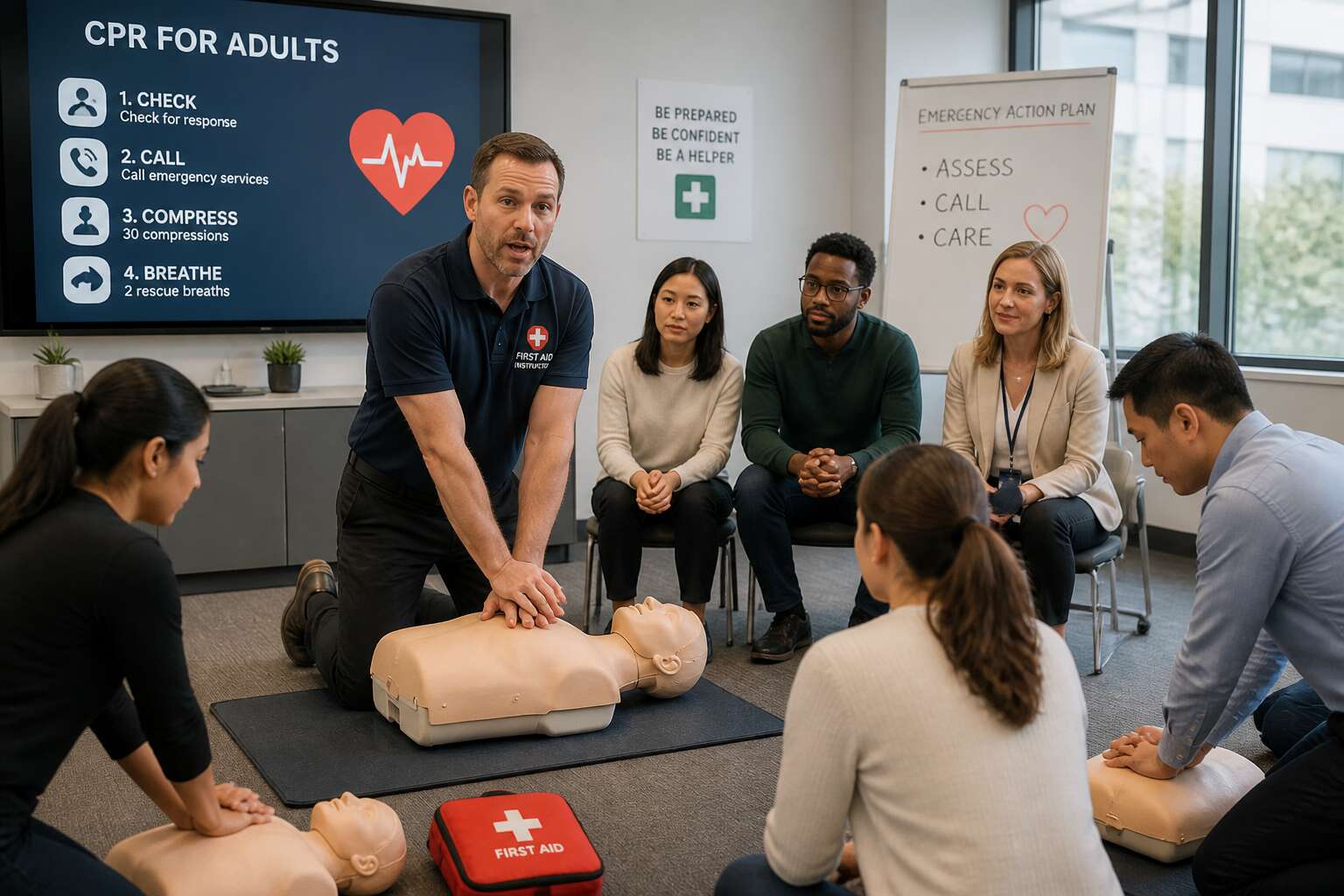
In emergency readiness, knowing and doing remain distinct. A company first aid course bridges that distance through deliberate, repetitive practice. Learners do not simply watch a CPR video. They press against mannequin chests to feel the exact depth required, and they handle automated external defibrillators until electrode placement becomes instinctive.
The sequence of response follows a clear rhythm:
- Check the scene and the person’s responsiveness.
- Call for emergency help and retrieve the defibrillator.
- Deliver compressions and follow the device’s verbal prompts.
Each repetition builds reliability. When an actual crisis occurs, hesitation fades. This practical foundation transforms a corporate office or factory floor into a place where bystanders become lifesavers.
Wound Care and Bandaging Techniques
Understanding wound care requires more than textbook knowledge. A company first aid course places bandaging techniques directly into your hands. Participants learn to differentiate arterial bleeding from venous oozing, and then practice applying pressure dressings that hold under movement.
Consider the core sequence:
- Assess the wound without contaminating it.
- Select the correct dressing, from gauze to elastic bandage.
- Secure the bandage firmly, never tight enough to cut circulation.
This practical repetition cements the correct technique. When a colleague suffers a laceration on the factory floor, your response no longer depends on guesswork. The course transforms theoretical steps into automatic action. That is the point where training becomes genuine preparedness!
Managing Fractures and Sprains
Fractures and sprains hide their severity behind swelling and pain. A company first aid course teaches participants to read those signals with precision. The difference between a torn ligament and a cracked bone is not always obvious, so training must be deliberate.
Practical sessions focus on immobilising the injured area before it sustains further damage. Learners work with splints, bandages, and slings, practising on realistic scenarios. They check capillary refill, monitor pulse points, and adjust support as needed.
The sequence is simple to remember:
- Stabilise the limb without attempting realignment.
- Secure the joint above and below the injury.
- Reassess circulation repeatedly while waiting for help.
South African workplaces benefit enormously from this hands-on drilling. When a colleague twists an ankle on uneven ground or takes a hard fall, the trained response is calm and effective. That is worth more than any manual.
Dealing with Choking and Breathing Emergencies
Choking deaths often happen in silence! A blocked airway gives no warning cry. That is why a company first aid course spends dedicated time on breathing emergencies. Participants learn to assess cyanosis, listen for stridor, and act before oxygen debt sets in. They practise chest compressions and rescue breaths on mannequins that measure effectiveness.
The intervention order is drilled relentlessly:
- Determine if the person can speak or cough.
- Perform five back blows between the shoulder blades.
- Switch to abdominal thrusts if the airway stays blocked.
- Begin CPR if the casualty becomes unresponsive.
I have watched this hands-on repetition build muscle memory. In a crowded workshop or open-plan office, that trained response makes the difference between a close call and a tragedy.
Medical Emergencies: Heart Attack and Stroke
Few things unsettle a workplace like a colleague collapsing. A heart attack rarely follows the dramatic clutching of the chest seen in movies. It can be nausea, jaw pain, or sudden fatigue. A stroke moves even quieter. The core curriculum of a company first aid course trains employees to recognise these medical emergencies through deliberate observation.
Practical skills include:
- Checking facial symmetry and arm strength.
- Asking the casualty to repeat a simple phrase.
- Noting the time of symptom onset.
Time remains the critical factor. Every minute of untreated stroke destroys neural pathways. The course builds speed in assessment and clarity in communication. That response can alter a family’s future.
Record Keeping and Incident Reporting
An unrecorded incident is an unseen risk. A company first aid course teaches employees that the moments after a crisis call for calm documentation as much as treatment. The practical curriculum builds a habit of writing down every relevant detail while the memory is fresh.
- The exact time and location of the incident.
- The casualty’s condition before and after care.
- The names of responders and witnesses.
That record feeds directly into incident reporting. A completed form becomes part of the company’s safety file, helping supervisors spot patterns and prevent repeat emergencies. Thorough reporting also satisfies legal expectations under South African labour law.
Maintaining and Refreshing Skills Over Time
Recommended Refresher Intervals
Competence decays. The hands retain procedures only as long as they are practiced. A company first aid course provides the foundation, yet time erodes every step. In South Africa, emergency protocols shift without warning. Refresher training is not a formality; it determines the quality of the response.
Recommended intervals depend on exposure and risk:
- Annual reinforcement for high hazard operations.
- Biannual updates for office environments.
- Quarterly drills for remote or isolated teams.
Some certifications demand renewal every three years, but muscle memory fades faster than paperwork. The fingers lose compression depth. The mind overlooks tourniquet sequence. Hesitation becomes the standard response in the absence of scheduled refreshers.
Creating a Culture of Continuous Safety
In emergency response, the gap between knowing and doing is measured in seconds. A company first aid course plants the initial skill, but continuity depends on daily culture. We weave short practice moments into ordinary South African work life, turning preparation into something unremarkable.
Maintaining skills becomes natural when teams feel ownership:
- Monthly scenario discussions based on real near misses.
- Peer-led kit inspections that double as learning sessions.
- Rotating volunteers to lead a quick response drill each quarter.
This rhythm builds collective memory. No one waits for a crisis to remember what to do. They already hold the sequence in their hands.
Integrating Training with Emergency Response Plans
Skills fade without deliberate practice. A company first aid course provides the initial foundation, but competence requires regular use. In South African workplaces, we hold quarterly scenario refreshers. These sessions reconnect staff with protocols they already know, keeping the sequence fresh.
Integrating training with emergency response plans means drills use actual floor layouts, emergency contacts, and equipment locations. Teams rehearse the exact chain of action, from the moment a call goes out to the moment help arrives:
- Assess the scene and establish safety
- Activate emergency contacts and retrieve equipment
- Provide first aid until professional responders take over
This alignment ensures the company first aid course becomes the engine behind every response plan. Regular practice and planned integration turn taught skills into lived responses without waiting for a crisis to reveal the gaps.
Measuring Training Effectiveness
Research shows that first aid skills decay within months without practice. A company first aid course builds the foundation, but maintenance is the real challenge. Measuring training effectiveness means looking beyond completion certificates. We track real performance during quarterly drills. We also review incident reports for repeated errors. This data reveals what the workforce actually retained.
- Response times from the moment a call goes out
- Correct sequence of actions under pressure
- Confidence when handling equipment
Each metric points to a weakness. Addressing that weakness keeps the training relevant. Over time, this feedback loop sustains competence. Without measurement, you are guessing. With it, you refresh skills long after the classroom ends.

0 Comments