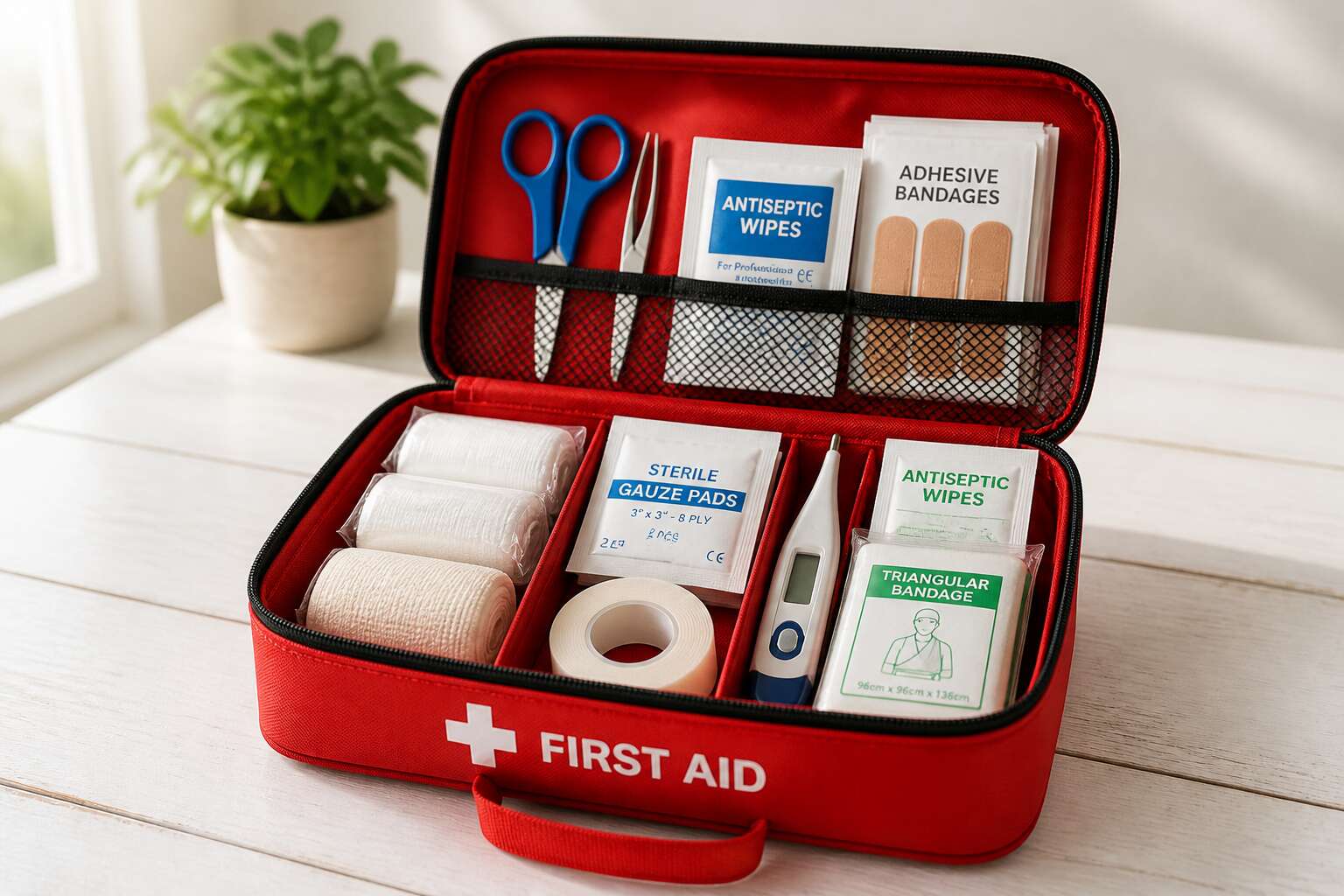
Essential Bandages and Dressings
Adhesive Bandages
The adhesive bandage rarely gets the credit it deserves. This unassuming strip of gauze and glue quietly resolves scrapes, blisters, and kitchen mishaps before they escalate. In my experience, it is the first thing people reach for when sorting out first aid kit items, and the one they truly understand.
Choosing well matters. Look for breathable fabric rather than stiff plastic, and a pad that releases cleanly from a healing wound. Waterproof versions earn their place in any coastal or Highveld household, where outdoor accidents are a weekend certainty!
- Fingertip strips for awkward joints
- Large pads for deeper grazes
- Hypoallergenic options for sensitive skin
Restock these regularly. Expired adhesive loses its grip, and a bandage that will not stay put serves no purpose. The reliability of your first aid kit items depends on such small details.
Sterile Gauze Pads
A well stocked medicine cabinet holds plasters and sterile gauze pads, but the gauze tends to run out first! These woven squares absorb exudate and shield delicate tissue from contamination, without clinging to healing skin the way cheaper dressings do.
Texture matters considerably. In my experience, coarse weaves aggravate; fine meshes comfort. Different situations call for different formats:
- Non-adherent pads for burns and abrasions
- Standard gauze for pressure dressings
- Crepe bandages for securing the pad in place
A well considered collection of first aid kit items includes gauze in multiple sizes. This quiet thoroughness is what sets genuinely prepared households apart.
Elastic Bandage
The elastic bandage is the quiet workhorse of any serious collection of first aid kit items. Many people overlook it, focusing instead on adhesive strips or antiseptic creams. This is a mistake. The elastic bandage is what transforms static dressings into dynamic support systems.
For the athlete, it offers compression for a strained calf or a swollen ankle. For the elderly, it can secure a dressing to a fragile limb without cutting off circulation. The key is knowing how to apply it with the correct tension. Too loose, and it provides no support. Too tight, and it becomes a hazard.
Consider the following capabilities that make these bandages indispensable:
1. Providing compression to reduce swelling after an acute injury
2. Securing dressings in place over joints prone to movement
3. Offering support to a weakened or unstable ligament
The material calls for a certain level of respect. A quality elastic bandage breathes, allowing the skin beneath it to remain healthy. Conversely, a cheap, synthetic alternative can trap heat and moisture, creating a breeding ground for discomfort. The application matters as much as the bandage itself.
For those who maintain their own first aid kit items, I recommend inspecting these bandages regularly. Check the elastic fibres for signs of wear. A bandage that has lost its stretch has lost its purpose. Keep them rolled tightly and stored in a dry space to preserve their integrity. In a moment of crisis, a reliable elastic bandage provides a measure of control, while a failing one introduces uncertainty.
Medical Tape
Every dressing is only as good as the tape that holds it. Ask any emergency doctor. They will tell you that the most common failure in wound care is not the antiseptic or the pad, it is the tape that failed at the wrong moment. I have learned to inspect tape before trusting it. Medical tape deserves more respect than it receives!
The South African climate, with its heat and humidity, demands a tape that breathes. Paper tape offers gentle adhesion for fragile skin. Cloth tape provides a stronger hold over joints and curved surfaces. Micropore tape allows moisture to escape while keeping the dressing anchored securely.
Your first aid kit items should include more than one variety of tape. Pay attention to the following when selecting and maintaining your tape!
- Porous tape prevents maceration
- Sunlight degrades adhesive bonds
- Old stock loses its grip
Butterfly Closures
Butterfly closures attract less attention than their bulkier counterparts, yet they solve a specific problem. A clean cut that gapes slightly, a flap of skin that refuses to lie flat. These tiny adhesive strips pull the edges together without the needle. They are the understated choice in wound care.
For the South African household, where table saws and braai tongs cause their share of mishaps, these strips serve a purpose. The adhesive side faces down, the narrow bridge sits across the wound line, and the skin remains unstitched but properly aligned. Many first aid kit items sit unused for years. Butterfly closures, however, are the ones you reach for when a stitch feels excessive and a plaster feels inadequate.
Trauma Dressing
Trauma dressings serve a critical role among first aid kit items. When a wound involves torn tissue or arterial bleeding, a simple plaster will not suffice. The trauma dressing delivers a bulky, absorbent pad held firmly by an elastic bandage. Its design permits sustained pressure, the primary tactic for halting severe blood loss.
For rural South African households, distance from a clinic can be measured in hours. This dressing earns its place. My own kit carries two sizes, because a knife wound on a farm hand does not wait for a paramedic.
- Moisture resistant outer layer
- Sealed backing for sterile storage
- Colour coded packaging for quick spotting
These features matter when every minute counts. A trauma dressing does not replace surgery, but it allows time, often the difference between recovery and lifelong consequence.
Tools and Instruments
Scissors
Scissors are essential first aid kit items. They cut through tape, gauze, and clothing. I prefer a blunt nosed pair because sharp points near skin can cause injury. For practical use, consider these features:
- Stainless steel blades that resist rust
- Angled tips for sliding under bandages
- Comfortable grips for wet hands
Angled blades let you lift a dressing without touching the wound. Stainless steel lasts through spills and repeated cleaning. Cutting fabric quickly matters during an emergency. This design remains the safest option for general use.
Tweezers
Tweezers are the quiet workhorses of first aid kit items. They remove splinters, stingers, and glass fragments with more precision than fingers ever will. I have pulled a cactus spine from a palm using only a decent pair and a steady hand. The key is the tip. Slanted tips offer better control than pointed ones for general use. Magnification helps, but a steady surface matters more.
Consider these features when choosing tweezers for your kit:
- Non-magnetic tips, so small metal fragments do not vanish
- A pointed tip for fine work and a flat tip for larger debris
- Anti-slip handles that work with sweaty fingers
Stainless steel construction resists rust after accidental washes. Cheap plastic tweezers bend and fail when you need them most. Quality steel pairs cost more, but first aid kit items only earn their keep under pressure.
Thermometer
In a household with small children, the thermometer is often the most consulted first aid kit item. A fever signals infection before other symptoms appear, and guessing at temperature with a palm on a forehead is unreliable. I have seen parents overmedicate based on a warm face and underreact to a true fever that left a toddler listless. Digital probe thermometers give accurate readings from mouth, armpit, or rectum. Ear models are quick but need proper positioning. Temporal artery thermometers work best on a squirming child, though they cost more.
When you choose a thermometer, look for:
- Flexible, waterproof probe
- Automatic shut-off to preserve battery life
- Memory function for tracking temperature changes
Rectal thermometers are precise for infants but must stay clearly separate from oral ones. No tool in the kit replaces clinical judgment, but a working thermometer gives you a number you can act on!
Disposable Gloves
A single pair of disposable gloves can interrupt the chain of infection between an open wound and a caregiver. This simple barrier keeps blood and bodily fluids at bay, a necessity when treating cuts, abrasions, or nosebleeds in a busy household. Not all gloves offer the same protection. Latex tears easily and can trigger allergies. Nitrile is more durable and resists punctures, making it the better choice for emergency care. Vinyl is cheap but uncomfortable and unsuitable for tasks requiring dexterity.
When you stock your supply, look for:
1. Nitrile material for tear resistance.
2. Powder-free inner surface to prevent contamination.
3. A snug fit that allows for touch sensitivity.
Having a supply dedicated solely to first aid prevents accidental contamination from kitchen or cleaning tasks. When you open a blister pack of gloves, you commit to a sterile action. This commitment turns a collection of supplies into a cohesive set of first aid kit items. One glove torn or worn from a previous use negates the entire purpose.
CPR Mask
Sekunjalo, the moment a heart stops, time itself becomes a merciless adversary. In the South African home, as elsewhere, a cardiac emergency leaves no room for hesitation. This is where the pocket mask, a humble tool among your first aid kit items, becomes an instrument of survival. It converts a panicked bystander into a confident lifeline, erasing the reluctance born from direct contact. The barrier it provides is the one between burial and a second chance.
The mask itself must feature a one way valve, a rigid piece of plastic that directs the exhaled breath away from the rescuer. This valve turns a simple action into a sterile, safe procedure. It also offers a physical seal against the face, directing a full, effective volume of air into the lungs rather than losing it to the air around you. Without this device, rescue breaths are less effective and riskier to perform.
For the design, you want a transparent shell to observe lip colour and obstructions. A compact case is essential; it must survive in a drawer for years, waiting for its single moment of service. An inflatable cushion or a silicone flange ensures a better fit over varying facial structures. Check these details so the mask works without fumbling in a crisis.
Safety Pins
Safety pins command little attention, yet they anchor much of what a first aid response relies upon. Within the broader collection of first aid kit items, they perform a supporting role. A dressing that stays exactly where you placed it, a sling that supports a forearm without constant adjustment. These outcomes depend on a small metal clasp that costs almost nothing.
The design dates back to 1849. The coiled wire at the hinge provides controlled tension, while the guarded tip protects your fingers during application. Adrenaline makes hands unsteady, and this small safeguard matters. I have seen a quality safety pin hold firm through an entire journey to a clinic, while a cheap one sprang open before the patient left the room. When you evaluate your first aid kit items, test the spring action of every pin.
Stainless steel resists corrosion better than plated alternatives. A concealed coil is easier to clean and less likely to snag on fabric.
Antiseptics and Medications
Antiseptic Wipes
Antiseptic wipes are the unsung heroes of any medical stash. They prepare the wound surface for the dressings we covered earlier. Without proper cleansing, even the best bandage becomes a liability. I always check the expiry date on mine. The active ingredient, often benzalkonium chloride or chlorhexidine, determines effectiveness. Here is what I look for in these first aid kit items:
- Individually sealed sachets to prevent drying out.
- A non stinging formula for sensitive skin.
- Sufficient friction texture to lift debris.
These wipes also handle minor abrasions and insect bites. Stocking them is a simple step toward proper wound care, yet many people overlook them entirely!
Antibiotic Ointment
Antibiotic ointment carries a function that most people misinterpret. Applying it feels passive, a smear of clear gel with no sting and no feedback. This lack of sensation makes it easy to dismiss. Yet broken skin requires a controlled environment to rebuild. The ointment maintains moisture and limits bacterial activity.
I have watched people accept the sting of antiseptic because pain feels productive, but they distrust the gentleness of a proper antibacterial layer. This hesitation has consequences. Wounds that stay moist and protected heal faster than those left dry. Resistance patterns in South Africa are shifting, and mupirocin based formulas often outperform older combinations.
Among first aid kit items, antibiotic ointment deserves deliberate placement. It works beneath the surface while the bandage protects that surface. Many people forget that ointment loses potency once exposed to air, a quiet failure that undermines their other first aid kit items.
Hydrocortisone Cream
Antiseptic solutions offer a sharp, clean sting against infection. That burning sensation is a form of honesty, a signal that the wound is being scoured. However, the body’s response to injury often outlasts the initial threat. Redness, swelling, and itch follow, and that is where hydrocortisone cream earns its place.
Hydrocortisone is among those first aid kit items that manage the aftermath rather than the cause. It suppresses inflammation, calming skin that reacts too fiercely to bites, contact rashes, or allergic patches. Antiseptics address broken tissue; hydrocortisone addresses unbroken irritation. I have seen many travellers err by applying both to the same open wound, which leads to a counterproductive clash.
- Use antiseptics for cuts, scrapes, and punctures where bacteria enter.
- Use hydrocortisone for rashes, insect bites, and eczema flares on intact skin.
These two treatments should never share the same surface. Respect the distinction, and your kit becomes more than a collection of supplies.
Antihistamines
When antiseptic wipes are too flimsy for a contaminated wound, liquid antiseptics like povidone iodine or chlorhexidine gluconate step in. They are staples among first aid kit items for good reason. A proper scrub with these solutions removes debris and bacteria before they settle deeper into tissue. I have seen minor cuts turn septic because someone relied on tap water alone.
Antihistamines deserve a separate drawer. They do not clean wounds, but they stop the histamine cascade that makes bites and rashes unbearable. Oral tablets like cetirizine work systemically, while diphenhydramine creams apply locally. Heat and swelling from an allergic patch often calm within thirty minutes.
- Use antiseptics when dirt or foreign matter invades broken skin.
- Use antihistamines when intact skin itches, swells, or flares from allergens.
Choose one treatment per symptom. Antiseptics for infection, antihistamines for allergic response. That distinction keeps your kit purposeful.
Burn Gel
Burn gel deserves a permanent place among first aid kit items. It cools damaged skin and forms a moist barrier that eases pain while shielding raw tissue from airborne bacteria. Antiseptics clean, burn gel heals. For a superficial scald from a kettle or braai flame, apply a generous layer immediately.
If the burn has broken skin with embedded dirt, use an antiseptic solution first, rinse, then cover with burn gel. Never do the reverse. Keep these boundaries in mind:
- Do not use ice directly on the burn.
- Do not pop blisters.
- Do not smear butter or oil.
The gel’s cooling action lasts for hours, so reapply as needed. Your kit remains purposeful when each item has a defined moment.
Emergency and Survival Additions
Emergency Blanket
A first aid kit is a quiet optimist until the moment it isn’t. The emergency blanket is its voice of reason. This shiny sheet of mylar is not for comfort. It is a policy against exposure, a barrier against the wind that saps body heat when shock or injury sets in. You will not see it used often, but when you do, the situation is serious.
The design reflects heat back to you and keeps moisture off. It solves the problem of rapid temperature loss with a membrane a fraction of a millimetre thick. Do not mistake it for a mirror. It is a thermal management tool for a body that has stopped regulating itself.
You can pair it with other first aid kit items to improvise a shelter, a sling, or a signal.
– Lay it over a patient on the ground to cut convective heat loss.
– Fold it into a narrow strip for a pressure bandage extender.
– Wrap it around a limb before splinting to add a layer of insulation.
– Crumple a section to use as a hand barrier between a screwdriver and a splinter.
These first aid kit items work best when you understand their limits. The blanket tears easily and conducts little cold protection from below. Place something between the patient and the ground if you can. The goal is to slow the loss of energy until a proper medical response arrives.
Instant Cold Pack
An instant cold pack is the first aid kit item that stops swelling with a simple chemical reaction. You snap the inner capsule, shake it, and the pack drops to near freezing in seconds. No fridge required. No waiting.
The value is in the timing. Soft tissue injuries demand rapid cooling to limit oedema and reduce pain. This pack delivers that response in the field, on the roadside, or in a workshop where ice is nowhere to be found.
This is one first aid kit item I keep within reach because inflammation does not pause for convenience.
- Reduce swelling from sprains and strains
- Cool minor burns without running water
- Numb an area before cleaning a wound
The pack is single use, so check the expiry date and replace it after any deployment.
Tourniquet
Among first aid kit items, the tourniquet makes people nervous. That’s fair. A device built to halt catastrophic bleeding demands respect. The modern tourniquet has evolved well beyond the crude battlefield versions.
The value is in the mechanics. A windlass rod twists to compress the artery, while a securing strap locks it in place. For severe limb haemorrhage, this is the difference between stability and crisis.
This first aid kit item earns its place through:
- Rapid application with one hand
- Windlass system for controlled pressure
- Broad band to minimise tissue damage
A properly applied tourniquet stays on until professional medical help arrives. Loosening it prematurely can dislodge clots and worsen bleeding. In the South African context, where emergency response times vary, I consider this kit item non-negotiable.
Eye Wash Solution
Dust storms, workshop debris, and airborne pollen are realities of South African life. A stinging, irritated eye can ruin an entire day. Worse, a chemical splash or metal fragment can cause permanent damage.
An eye wash solution is a specialised item that addresses this specific vulnerability. A standard kit focuses on wound care, but the eye is a different matter entirely. A gentle saline rinse flushes away contaminants and soothes the affected surface. For a comprehensive medical kit, this addition is a sensible, practical choice.
- A sterile saline formula, matched to the eye’s natural pH.
- A sealed, single-use container to prevent cross-contamination.
- A delivery nozzle designed for accurate application.
This is not about treating infection. It is about immediate, physical relief from irritants before they escalate. For anyone working with machinery, chemicals, or simply navigating a windy Highveld afternoon, this specific first aid kit item bridges the gap between a nuisance and a medical emergency. It is a quiet, sensible provision for a part of the body we often take for granted.
First Aid Manual
A first aid manual is the most underrated item in a serious medical kit. It cannot stop bleeding or splint a fracture, but it explains exactly how to do both. In South Africa, help can be an hour or more away, and that knowledge often determines the outcome.
Emergency and survival additions extend the kit’s reach. Consider these first aid kit items:
- A headlamp with spare batteries
- A whistle for signalling
- Water purification tablets
- A fire starter for warmth
These first aid kit items serve rare but critical moments. A knife, duct tape, and a multitool earn their place when a situation turns complicated.
The manual ties everything together. It turns supplies into sequenced decisions. When the power goes out during loadshedding, or a farm worker collapses far from help, the manual guides your next move. The additions provide the means. The manual provides the method.
Emergency Whistle
When you think of first aid kit items, the emergency whistle rarely makes the mental cut. This is a mistake. In the chaos of an accident, your voice is a finite resource. Shouting until your throat is raw consumes energy you need for survival and produces a sound that fades fast.
An emergency whistle solves for distance and durability. A sharp blast carries much further than a human cry and requires almost no physical effort. In the South African bush or on a remote farm, sound is often your only line to the outside world. The whistle turns an invisible problem into a loud, trackable signal. It offers a straightforward advantage: you stay quiet and conserve strength while the sound does the work.
A few practical uses for this unassuming tool include:
– Alerting a search party to your location when you are disoriented
– Scaring off opportunistic wildlife probing a camp in the dark
– Coordinating with a partner when visual contact is lost
The simplicity is the point. No batteries. No moving parts. Just a reliable noise that tells rescuers precisely where to look. It is a small addition with a single job, and in a crisis, that focus matters.
Customizing for Specific Situations
Family and Children
Families with children need a different approach when assembling first aid kit items. A standard adult kit misses pediatric nuances, like measuring doses and calming tears. In South Africa, where outdoor braais and beach days are common, scrapes and insect bites dominate.
Start with age appropriate basics. Add a liquid paracetamol with a proper dropper, and a child sized medical tape that won’t hurt little skin. These small adjustments make a real difference!
Consider extra supplies for young ones:
- Oral rehydration salts for stomach bugs
- Aqua gel sachet for minor burns
- Child ID card with emergency contacts
This tailored selection ensures your supplies actually work when your child needs them most.
Outdoor and Adventure
The veld does not negotiate. A slip on a wet stone beside a mountain stream, a snake striking from a shaded patch of grass, these events arrive without warning. For those who venture into the kloofs or along the coast, the standard house kit is a mockery. It lacks the specific weight and utility required for survival when the nearest help is hours away.
I have learned that a kit for the wild must be a heavier beast, built for the environment itself. It should include a tourniquet and a compression bandage for haemorrhage control, but also a dedicated snakebite kit with a suction pump and firm instructions to keep the victim still. These first aid kit items are your only defence when the sun dips behind the mountain.
– A thermal blanket designed for extreme temperature loss
– A waterproof torch with a red light setting to preserve night vision
– A multi-tool capable of cutting through thick clothing or webbing
The day walker’s bag is a lighter affair, yet it demands respect. Sun exposure at altitude is a silent assailant, so a high SPF cream and a zinc oxide stick for the lips are non-negotiable. Ticks and stingers are a constant threat, so a pair of fine-pointed tweezers and a small vial of antihistamine cream are essential. The transition from late afternoon to the chill of dusk is sudden, and a kit that cannot adapt to that shift is a burden, not a boon.
Workplace and Office
An office environment presents a different set of risks than the veld. A warehouse floor or a corporate kitchen creates hazards that are mundane, yet persistent. I have seen a simple paper cut turn into a serious infection because the kit held only a plaster. The OHS Act in South Africa requires employers to provide adequate first aid provision, and that means choosing first aid kit items that match the daily reality of the building.
For a workplace, a few specific first aid kit items are worth adding:
- An incident log book, a legal requirement under the OHS Act
- Rehydration sachets for summer heat that strikes office blocks
- Finger cots for small wounds exposed to dirt
A storeroom with chemical cleaning supplies requires a spill response plan beside the kit. The office kit demands monthly inspection, because a depleted kit is a liability.
Vehicle and Travel
Travel changes the calculus of emergency care. A broken radiator hose or a punctured tyre on a remote gravel road means help may be hours away. The boot of a car serves as your treatment area, and the kit inside it must account for longer response times.
For vehicle travel, add a triangular bandage for immobilising a shoulder or creating a sling. A compact torch helps you work in the dark. Consider haemostatic gauze for deep wounds, though it requires training. Keep first aid kit items accessible, not buried under luggage.
The heat inside a parked car degrades adhesive and medication. Store the kit in a cooler bag during summer months.
Pet First Aid
In South Africa, veterinary emergency rooms see a surge of snakebite and tick fever cases each spring, yet most pet owners keep zero bandages within reach. Pet first aid demands its own inventory, distinct from human first aid kit items. Paracetamol is deadly to dogs, and a muzzle prevents a frightened animal from compounding an injury with a bite.
A proper pet kit goes beyond basics. Include a tick remover for wildlife encounters, haemostatic powder for nail tears, and saline solution for flushing irritated eyes. Wrap gauze loosely; a tight wrap cuts circulation.
For your pet’s kit, consider:
– A muzzle or soft fabric
– Waterproof tape for splinting
– Instant glucose paste for hypoglycaemic episodes
I recommend storing the kit near your dog’s leash, not in a cupboard. Heat and humidity in Johannesburg or Durban degrade adhesive, so refresh the contents every season!

0 Comments