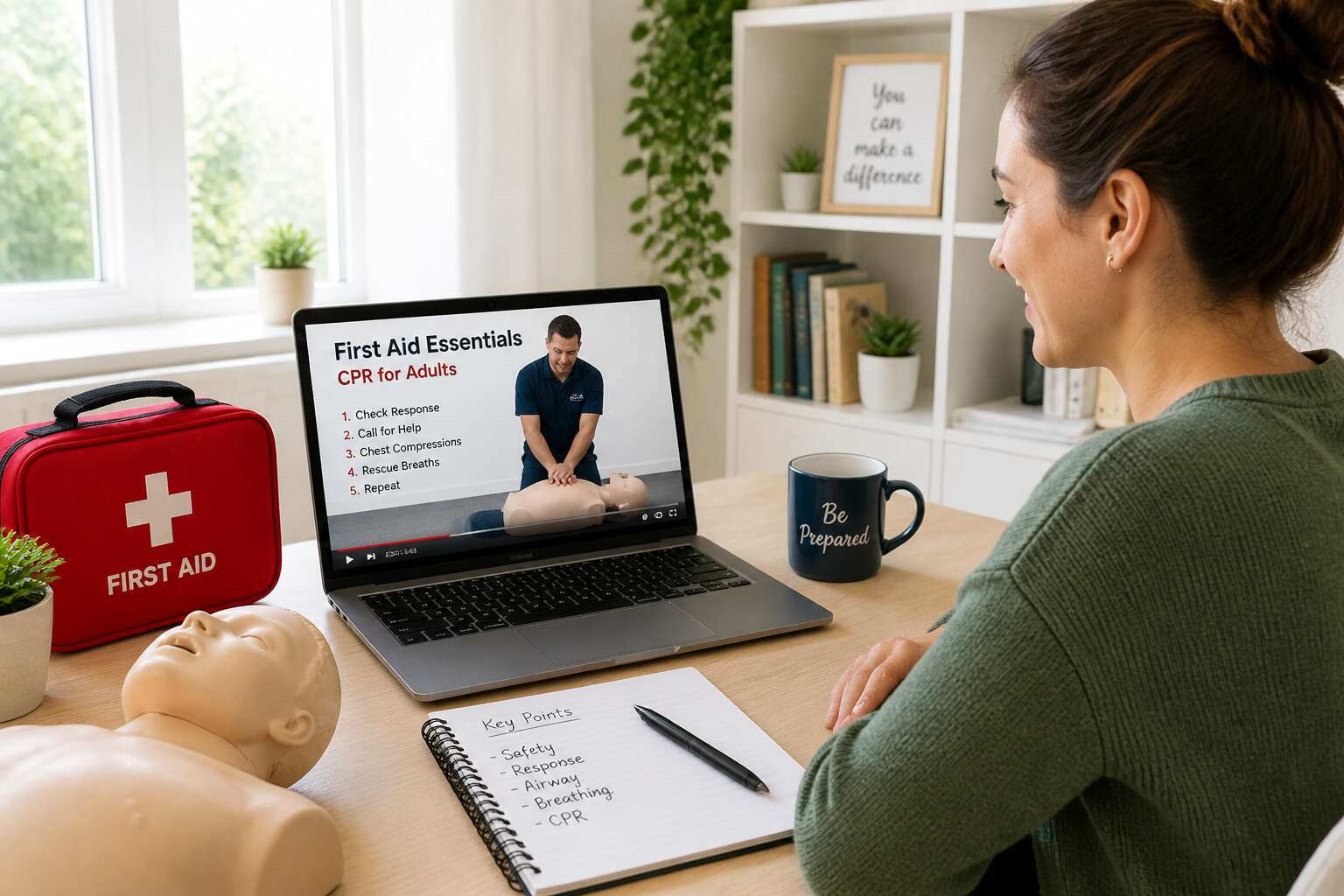
Why Workplace First Aid Training Matters in the UK
Legal Responsibilities Under the Health and Safety Executive
The Health and Safety Executive doesn’t mince words. Every UK employer carries a legal obligation to ensure adequate first aid provision. This isn’t bureaucratic fussiness; it’s the difference between a minor incident and a catastrophe.
Under the Health and Safety (First-Aid) Regulations 1981, workplaces must assess their specific risks. A construction site demands different provisions than a call centre. The HSE expects employers to examine:
- Staff numbers and shift patterns
- The nature of workplace hazards
- Proximity to emergency services
Completing a first aid course uk online offers a practical route to meeting these legal duties. Yet certification isn’t permanent! I’ve seen too many employers let training lapse, leaving them exposed to enforcement action. A first aid course uk online should be refreshed regularly to keep skills sharp and compliance intact.
How Many First Aiders Does Your Business Need
In cardiac arrest, survival drops roughly 10 percent for each minute without defibrillation. That statistic anchors why workplace first aid training matters in the UK. A trained responder delivers immediate care, preserving life during the crucial window before professional assistance arrives.
How many first aiders does your business need? In my experience, your risk assessment determines the figure, not guesswork! Consider these elements:
- Low hazard environments typically require one appointed person per fifty employees
- High risk operations may need multiple certified responders per shift
- Remote locations demand enhanced coverage where ambulance response runs longer
A first aid course uk online certifies employees without halting workplace momentum. Team members study remotely and then validate their competence through hands-on assessment. For businesses operating across various sites, an online first aid course uk online unifies training standards while adapting to individual schedules.
Reduced Risk and Faster Emergency Response
Sudden cardiac arrest leaves roughly four minutes before brain damage begins. On a busy UK work site, that is barely enough time for an ambulance to arrive. A trained colleague who acts immediately changes the outcome. They assess the scene, check responsiveness, and begin chest compressions without hesitation.
This speed reduces risk across the entire organisation. Employees who complete a first aid course uk online learn to spot early warning signs, from dizziness to irregular breathing, before a situation escalates into an emergency. What I see in properly trained teams is a quiet confidence that replaces panic.
Faster response produces measurable effects:
- Bleeding is controlled within seconds of an incident
- Airway obstruction is cleared before consciousness is lost
- CPR starts while the emergency line is still connected
When every second matters, trained hands make the difference. A first aid course uk online prepares your team for that exact moment.
Industry-Specific First Aid Requirements
Across the UK, a warehouse floor and a corporate boardroom are not the same environment. The risks are different, which means the training must adapt. A generic approach to workplace safety fails to account for the specific hazards employees face daily. This is why a first aid course uk online must be evaluated against your sector’s unique demands, not treated as a one size fits all solution.
Consider the sheer variety of workplaces that require compliance:
– Construction sites grapple with falls, crush injuries, and exposure to hazardous materials.
– Manufacturing plants face risks involving heavy machinery, burns, and chemical spills.
– Office environments contend with musculoskeletal issues and sudden medical events like cardiac arrest.
– Hospitality venues handle scalds, cuts, and the occasional allergic reaction from customers.
The type of responder you need depends entirely on this context. A course designed for an administrative office will not adequately prepare someone for a factory floor where a torn tourniquet or a suspected spinal injury calls for different protocols.
Your workforce’s demographics also play a role. An ageing workforce might face a higher incidence of strokes or heart attacks, while younger teams could be more prone to sports related injuries during breaks. The content of your chosen first aid course uk online should reflect these realities. It should bridge the gap between standard protocol and your operational reality, ensuring your appointed people are ready for the incidents most likely to occur on your property, not just the textbook scenarios.
What to Look For in an Online First Aid Course
Accredited Certification and Regulated Qualifications
Consider this: a UK watchdog recently stripped accreditation from two online first aid course providers because their entire assessment was a multiple choice quiz. You could pass that with a good guess. When you shop for a first aid course uk online, the accreditation details matter more than the price or the pretty website.
Regulated qualifications come from awarding bodies like Qualsafe or Highfield. These bodies answer to Ofqual, which is the authority. Your certificate should name the specific qualification, not merely say “first aid trained.” Ask the provider to share their centre number and the qualification’s unit code.
- Check the awarding body on Ofqual’s register.
- Confirm the course covers practical skills via live video.
- Verify the certificate’s expiry date is three years.
If the provider hesitates, that tells you everything. A valid course will present its paperwork without delay.
Course Content and Practical Skill Coverage
Once you have confirmed the accreditation is legitimate, the real work begins. That is the curriculum. A first aid course uk online can look impressive on the surface, yet disappear into a theoretical PowerPoint village when you actually need to respond to a casualty. You want to see a syllabus that makes your brain sweat a little.
A quality course should cover more than the recovery position and a vague nod to CPR. You need to assess a scene, manage an airway, and handle catastrophic bleeding. The practical element matters. That means live demonstration. The instructor should physically show you how to apply a tourniquet or use an AED, then ask you to repeat the motion on camera. Watching a pre-recorded video is not the same as having your hands guided by someone who has actually used a first aid kit on a real human. This is where the virtual format can either shine or fail spectacularly.
The syllabus should include these core skills to feel genuinely useful:
- Primary and secondary surveys to identify life threats.
- Choking management for adults, infants, and children.
- How to handle shock, anaphylaxis, and seizure activity.
- Chest compressions with correct depth and rate feedback.
If the course skips any of these in favour of more slides about legal jargon, you are paying for a slideshow. A first aid course uk online should make you feel slightly overwhelmed by the responsibility, not bored by the content. If the provider offers a short trial module or a syllabus preview, take it. That preview will tell you instantly whether the training is a serious endeavour or a tick box exercise. The good courses will eagerly show you what is inside. The dodgy ones will keep the content a mystery, and that mystery is not adorable, it is dangerous.
Instructor Support and Assessment Methods
Another statistic worth considering: nearly 60% of online learners report that a lack of instructor interaction is the primary reason they abandon a course. That is relevant when you evaluate a first aid course uk online. A pre-recorded feed with a contact form is not support. You want live Q&A sessions, scheduled check-ins, and an instructor who reviews your technique videos with a critical eye.
Assessment should test more than recall. Look for courses that require video evidence of chest compressions with feedback on depth and rate. Ask about resubmission pathways if you fumble an attempt. Some providers run virtual breakout rooms where you manage scenarios while the instructor watches your reactions.
A solid provider will offer:
– Video submissions reviewed by certified trainers within 48 hours
– Live practical assessments through video call
– Scenario based questioning that measures decision making under pressure
If a first aid course uk online cannot describe its assessment process clearly, that is a warning signal. You need accountability, not a certificate mill.
Certification Validity and Renewal Requirements
A certificate without a renewal date is worthless in an audit. Most first aid course uk online qualifications expire after three years, but your skill level drops much faster. The renewal process is where you rebuild competence, not just pay for another card.
Ask providers directly about their requalification requirements. Do they run a condensed version of the full course? Some offer annual refresher modules, others demand a full practical reassessment. Look for a structure that includes live scenario practice.
- Verify the certificate shows the issue date and expiry date
- Confirm the renewal syllabus matches current guidelines
- Check if your employer recognises the provider’s certification
A first aid course uk online that cannot outline its renewal procedure leaves you exposed.
Compatibility With Mobile Devices and Offline Access
57% of smartphone users check their devices within five minutes of waking up. Your training platform must meet you where you already live, on that glowing rectangle in your pocket. A first aid course uk online that forces you to huddle around a desktop monitor misses the entire point. The best platforms render beautifully on a six inch screen, with buttons you can actually tap while holding a mug of coffee.
Here in South Africa, load shedding and network dead zones are a real obstacle. You cannot afford a course that vanishes when the signal does. Seek out a provider that lets you download the full module library to your device. That means offline access to video demonstrations and PDF manuals, allowing you to study in a park or during a long taxi ride without burning your data bundle.
Your study package should include:
– Downloadable video lessons for bandwidth free revision
– Interactive quizzes that work in airplane mode
– A mobile friendly interface with responsive design
The interface should feel intuitive, not like a miniature version of a bloated website. Clear menus and simple navigation prevent frustration, keeping your focus on the skills rather than the software.
Comparing Online and Classroom First Aid Training
Flexibility and Self-Paced Learning
Choosing between an online and classroom first aid course uk online offering often comes down to how you learn best. Classroom sessions follow a strict timetable, requiring you to attend at set hours. Online training, however, lets you study when your day allows. That freedom proves valuable for shift workers or busy parents.
Self-paced learning means you can revisit a tricky demonstration again. You might pause a video to practice chest compressions on your own time. This flexibility does not diminish the quality of accredited material.
- Study during lunch breaks
- Pause and rewind complex topics
- Complete the course across multiple days
Classroom settings offer immediate feedback, but online modules give you control over your schedule. For many South Africans balancing work and family, the convenience of a first aid course uk online outweighs the rigid format of in person training.
Hands-On Practice Versus Virtual Demonstrations
Performing CPR on a plastic mannequin exposes flaws a screen cannot. Classroom drills force an instructor to correct your hand placement mid-cycle. A first aid course uk online offers video loops you can isolate frame by frame. Freeze the shot at full recoil! Study the wrist angle. Replay it ten times without slowing the group.
Some digital platforms use branching scenarios. You make a choice, and the virtual casualty responds accordingly. This replaces physical cues with cognitive pressure. For South African learners in remote towns, travel costs come down. The differences break down like this:
- Classroom: tactile feedback, live correction
- Online: repeatable demonstrations, consistent assessment
Virtual training loses the raw feel of ribs compressing under your palms. But home practice with a sensor mat and a first aid course uk online submission verifies depth and pace. The tradeoff remains, yet the options now overlap.
Cost and Time Savings for Employers
Employers often overlook the ledger of lost hours. A classroom session for a dozen staff means twelve commutes, a venue, and a morning of muted productivity. The arithmetic stings! An online option collapses that overhead into a single subscription.
Consider the cost per employee: travel reimbursements, catering, printed manuals. These expenses vanish with remote learning. The first aid course uk online also allows staggered completion, so your team can train across shifts without halting operations.
- No venue hire
- No travel time
- No collective downtime
For South African employers, where distances are vast and load shedding disrupts schedules, this flexibility is not trivial. It is a fiscal relief and a scheduling grace.
Blended Learning Options for Practical Assessment
Most first aid courses are taught entirely in a classroom or entirely on a screen. Blended learning maps a middle path, and it is changing how South African staff get certified. You complete a first aid course uk online, then attend a short in-person session solely for the practical assessment. This structure cuts travel time and venue costs while keeping the element that matters most: an instructor watching your hands. The first aid course uk online portion covers the theory, and the face-to-face meeting verifies your skill. A typical assessment runs like this:
1. You perform CPR on a manikin while the instructor times your compressions.
2. You apply dressings and bandages to a simulated wound.
3. You manage a staged emergency scenario.
The instructor corrects your technique on the spot. There is no classroom downtime, no repeating content you already learned online. You leave with the same regulated certification as a full classroom delegate, but with far less disruption to your week.
Step-by-Step Guide to Completing Your Online First Aid Training in the UK
Choosing the Right Level and Syllabus
The wrong level of first aid training costs more than money, it costs competence. Choosing the right level for a first aid course uk online starts with a thorough audit of your workplace hazards, not a guess. A warehouse has different injury patterns than an office.
Next, compare the syllabus titles because the words “basic” and “advanced” are not interchangeable across providers. Look for listed modules that address your specific risks, such as burns or fractures, and ignore anything that promises universal fixes.
- Map the syllabus against your risk assessment, not a generic checklist.
- Compare the qualification levels to the response times your staff need.
- Read the course outline for the specific injuries covered.
The right training leaves you with zero redundant modules and every necessary skill accounted for.
Booking Your Course and Setting a Study Schedule
Booking a first aid course uk online takes minutes. Completing it takes discipline. I have watched learners pay for excellent training, then never open the platform again. The process is straightforward, but you must treat it as a professional obligation, not a spare time activity.
Start by booking your course for a date that aligns with your workload. Then build a study schedule immediately. Here is a method that works:
1. Block two or three short sessions per week across one month.
2. Set calendar alerts that nudge you before each session.
3. Pair each module with a hands-on demonstration at your desk.
South African professionals often overlook time zone differences. A UK provider’s live support hours may not match your afternoon. Verify this before booking, because a missed session delays your qualification. Commit to the schedule, and the certificate follows!
Working Through Modules and Interactive Scenarios
Let’s be honest, the moment you finally log into your first aid course uk online, the real challenge begins. A glowing screen and a curriculum waiting for you can feel less like education and more like a dare. The modules are the meat of the operation, and they require a distinct type of focus. You will sit through video demonstrations and read through text-heavy slides, and it is easy to let your eyes glaze over. However, the true test arrives with the interactive scenarios, which force you to apply the theory before your brain has the chance to file it away as background noise.
The interactive segments are where the learning sticks. They drop you into a simulated emergency and ask for a decision. It is a strange sensation to feel your pulse quicken over a virtual casualty, but that reaction serves a purpose. It mimics the pressure of a real incident. You will work through branching paths in the learning management system, and the system will sometimes correct your choice in a way that feels personal. It is not just a lecture. It is a rehearsal.
– The first pass is for familiarity. Watch the content and don’t worry about the quiz.
– The second pass is for retention. Use the notes feature to capture the sequencing of protocols.
– The final pass is for speed. Run the scenarios until the correct response feels automatic.
Some providers sprinkle in gamified elements, such as leaderboards or scoring. Resist the urge to ignore them. The pressure of a digital scoreboard is a useful proxy for the stress of a real emergency. When you finish the final module and the system confirms your completion percentage, you will realise the certificate is simply a by-product of the process. The real achievement is the shift in your muscle memory, which is the ultimate return on your investment in a first aid course uk online.
Passing the Final Assessment and Receiving Your Certificate
The final assessment decides whether you pass or repeat. The system shuffles questions from each module, and the pass mark sits at 80%.
- Revise the protocol sequences, especially CPR ratios.
- Take a mock test to expose weak spots.
- Attempt the real assessment in a quiet space.
Clear that threshold and the certificate generates instantly as a PDF. Most providers upload it to your dashboard within minutes. For a first aid course uk online, this document is accepted in UK workplaces, and South African employers recognise the international standard. Download a backup copy immediately. Losing your certificate means paying for a replacement.
Adding Your Qualification to a CV or Employee Records
Once your certificate is downloaded, update your CV within the same week. Recruiters in South Africa scan for health and safety credentials early. List the qualification under a dedicated certifications section. Include the provider name, completion date, and accreditation body. Completing a first aid course uk online gives you a portable credential that travels across borders.
For employee records, send a copy to your HR department. They need to log the expiry date and renewals. Many payroll systems track this automatically. If your employer paid for the first aid course uk online, note that on the internal training register. Keep your own copy synced to cloud storage. The original PDF remains the only proof auditors accept.
Staying Up to Date With CPR and Defibrillator Protocols
The rhythm of resuscitation science is not static, it is a living, breathing thing that evolves with each new study. A first aid course uk online gives you the scaffold, but the muscle memory requires constant tuning. What was considered best practice five years ago may now be a relic, replaced by streamlined techniques that prioritise chest compression depth and minimal interruptions.
When you enrol, seek out providers who explicitly mention protocol updates in their syllabus. They should reference the latest Resuscitation Council guidelines. Look at how the course handles the transition from adult to paediatric care, as the ratios differ significantly. Defibrillator usage, once a source of anxiety for many, is now demystified through clear, repetitive virtual demonstrations.
To maintain your edge, adopt a simple review rhythm:
– Revisit the compression rate module every six months.
– Practise the voice-guided AED steps in your head before sleep.
– Watch the updated airway management video before the certificate renewal reminder arrives.
– Test yourself on the shock delivery sequence, which remains the most critical element for sudden cardiac arrest survival.
These small, deliberate acts of review ensure that when an emergency occurs, your hands remember what your mind has already accepted. The online platform offers the flexibility to do this, without the pressure of a classroom clock. Your knowledge becomes a durable asset, refined through habitual re-engagement rather than a single, fleeting session.
Common Questions About Online First Aid Certification
Are Online First Aid Certificates Valid in UK Workplaces
Many South African readers ask whether a UK online certificate carries any weight outside the UK. Inside UK workplaces, however, the question is simpler. A first aid course uk online leads to certification that employers accept, provided the course provider follows the strict parameters set by the official guidance.
What often surprises people is that the certificate itself does not reveal the delivery mode. It looks identical to one earned in a lecture hall.
- Check the issuing body’s name and logo.
- Compare the qualification number with the official framework.
- Ask the provider for their internal quality assurance policy.
That final check reassures employers without requiring a hard copy.
Do You Need Practical Experience Before Certification
Every week, we hear someone ask whether they must touch a mannequin or hold a bandage before enrolling. The honest answer is no. A first aid course uk online accepts learners with zero practical background, and the training itself supplies the experience you need.
The final assessment does not test your past. It tests your grasp of the material presented in the course. Instructors observe your decision making through interactive scenarios, and your responses demonstrate whether you can apply the protocols. This aligns with what an employer actually checks.
Here is what the provider expects from you before you start:
– Basic literacy in English
– A reliable internet connection
– A commitment to finish the modules
Nothing more. You are not required to work in healthcare, hold a prior certificate, or prove any hands-on ability in advance. The qualification you earn reflects the course you complete, not a biography you bring to it.
How Long Does an Online Course Take to Complete
A first aid course uk online rarely locks you into a rigid timer. Most providers design their programs to respect your existing schedule. The core content, including video demonstrations and scenario work, typically spans five to eight hours of active learning. Some learners finish over a single weekend. Others prefer to work through two modules each evening after work.
Your enrolment period is the real boundary. Most platforms grant access for twelve months, which removes any sense of panic. The final assessment sits ready whenever you feel prepared. This is important for busy parents or shift workers who cannot predict their free time.
A practical way to pace yourself is to think in small blocks.
– Spend ninety minutes per sitting on one module.
– Take a short break before attempting the quiz.
– Return the next day to start a fresh section.
– Reserve the final hour for the assessment.
The speed of completion matters less than your grasp of the material. A quick two day sprint works for some, while a fortnight of steady progress suits others. Assessors do not record how quickly you passed. They confirm whether you met the standard for the first aid course uk online you chose. Choose a pace that lets you revisit the serious topics, such as CPR protocols, without feeling rushed. The certificate you hold at the end carries the same weight, whether you earned it in a weekend or across three relaxed weeks.
What Is the Difference Between a Level 2 and Level 3 Course
Choosing between a Level 2 and Level 3 first aid course uk online often confuses people. Level 2 focuses on essential emergency response. You learn CPR, bleeding control, and how to handle unconscious casualties. Level 3 goes deeper. It includes managing a wider range of injuries and understanding the legal duties of a first aider in the workplace.
The Level 3 qualification suits those who act as designated first aiders under HSE requirements. A Level 2 certificate works well for general staff awareness. I often tell learners to consider their role. Ask yourself these questions:
- Do you work in a low risk office environment?
- Are you responsible for multiple employees?
- Does your job require advanced casualty assessment?
Your answers will point you toward the right level. The best first aid course uk online will clearly state which level matches your needs.
Can You Renew Your First Aid Certificate Online
Many learners ask whether renewal can happen entirely online. The answer depends on the awarding body. Some offer online refresher modules, while others require a blended approach. Your current certificate often dictates the path. The best first aid course uk online providers list renewal options clearly before you pay. I always advise checking the expiry date first. Renewing is rarely as demanding as the initial certification. Still, you must verify the regulated qualification status. One quick way to confirm is to inspect the training provider’s credentials. Another is to contact the awarding organisation directly. A few simple checks prevent wasted time and money.


0 Comments